VFR · Lesson 75 · 8 min · ACS PA.XI
Night Illusions and Airport Lighting
Reviewed by a panel of three CFIs + AI review
Summary
Beware the black hole, autokinesis, and false horizons; read the beacon, runway, and threshold lights and the VASI/PAPI; and key the mic 7/5/3 to control the lights where they are pilot-activated.
Also watch
Quick check ▾
One question on what you just read.
Question 1 of 1
Night visual illusions · Topic mastery: Not started
Exit0 of 1 answered
The black-hole approach illusion most typically causes a pilot to do what?
Why this matters in flight
Night illusions have flown healthy pilots into the ground on perfectly good approaches. Reading airport lighting correctly — and knowing how to turn it on yourself — keeps a night arrival stabilized and safe.
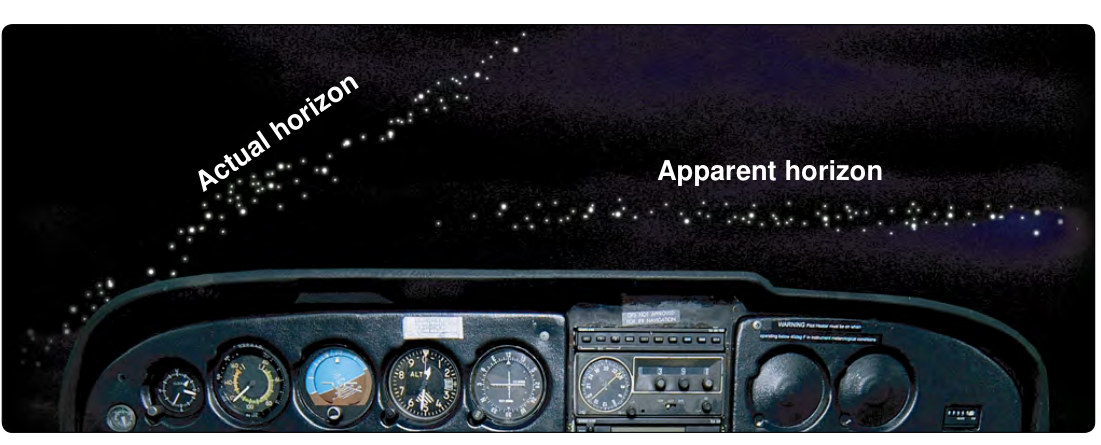
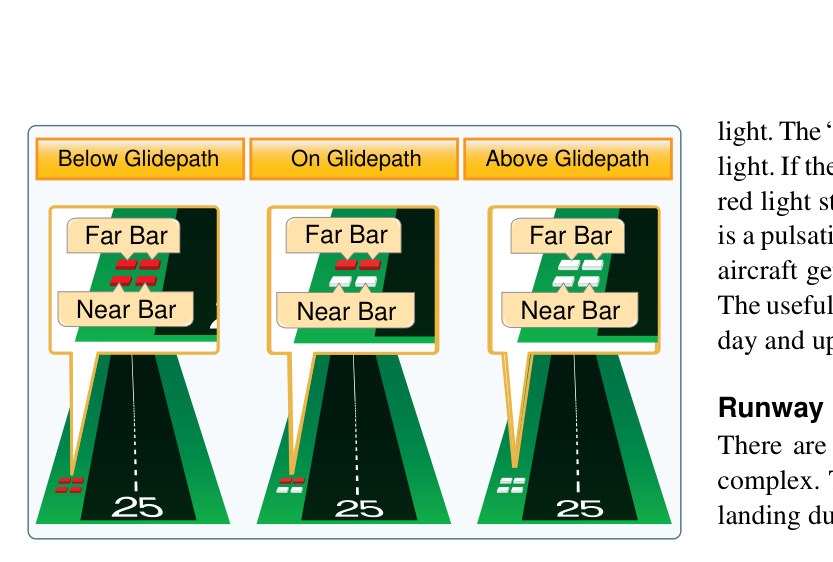
Darkness removes the visual references your brain relies on, and it invents a few false ones. The black-hole approach happens over dark, featureless terrain or water: with nothing to judge height against, pilots tend to fly dangerously low, so a visual glideslope aid becomes critical. Autokinesis makes a single steady light seem to drift if you stare at it, and a false horizon from sloping clouds or blended ground lights and stars can tempt you to bank toward the wrong reference. Airport lighting is your antidote. A rotating beacon flashing white and green marks a lighted land airport; runway edge lights are white, taxiway edge lights are blue, and green/red lights mark the thresholds. A visual glideslope aid shows your descent path: on a two-bar VASI, red over white means on the glidepath; on a four-light PAPI, two white and two red means on the glidepath. At many untowered fields the lights are pilot-controlled: key the mic 7 times for high, 5 for medium, and 3 for low intensity on the published frequency.
Key terms
- Black-hole approach
- A too-low approach over dark, featureless terrain with no height cues.
- Autokinesis
- The illusion that a fixed light is moving when stared at.
- Pilot-controlled lighting
- Runway lights activated by keying the microphone on a set frequency.
Sources & references · 3 · 4 linked
Every claim traces to a source — paraphrased knowledge elements pointing at the governing FAA publication. Items marked verified have been checked against the retrieved source text; the rest are pending verification. Where the exact page or regulation has been located in a retrieved document, the source links straight to it.
- AIM 8-1-5 / PHAK Ch. 17 — Aeronautical Information Manual verifiedAIM 8-1-5 (p. 51)
- AIM 2-1 / AIM 2-3 — Aeronautical Information Manual verifiedAIM 2-1 (p. 109)AIM 2-3 (p. 127)
- AIM 2-1-9 — Aeronautical Information Manual verifiedAIM 2-1-9 (p. 41)
Community
Ask for more detail or suggest additions to make this lesson better. Community input — not authoritative and not CFI-reviewed.
Sign in or create a free account to join the conversation.
No comments yet — be the first to help improve this lesson.