VFR · Lesson 68 · 9 min · ACS PA.I.H
Flying Solo Well: SRM, Workload and Situational Awareness
Reviewed by a panel of three CFIs + AI review
Summary
SRM lets one pilot do a crew’s job by managing resources, workload, and awareness. Prioritize to avoid saturation, and guard situational awareness against fixation, fatigue, and complacency.
Also watch
Quick check ▾
One question on what you just read.
Question 1 of 1
Single-pilot resource management · Topic mastery: Not started
Exit0 of 1 answered
Single-pilot resource management (SRM) is best described as what?
Why this matters in flight
A single pilot has to do alone what an airline crew shares among several people. Managing your resources, your workload, and your awareness is what keeps a solo cockpit from quietly overwhelming you at the worst possible moment.
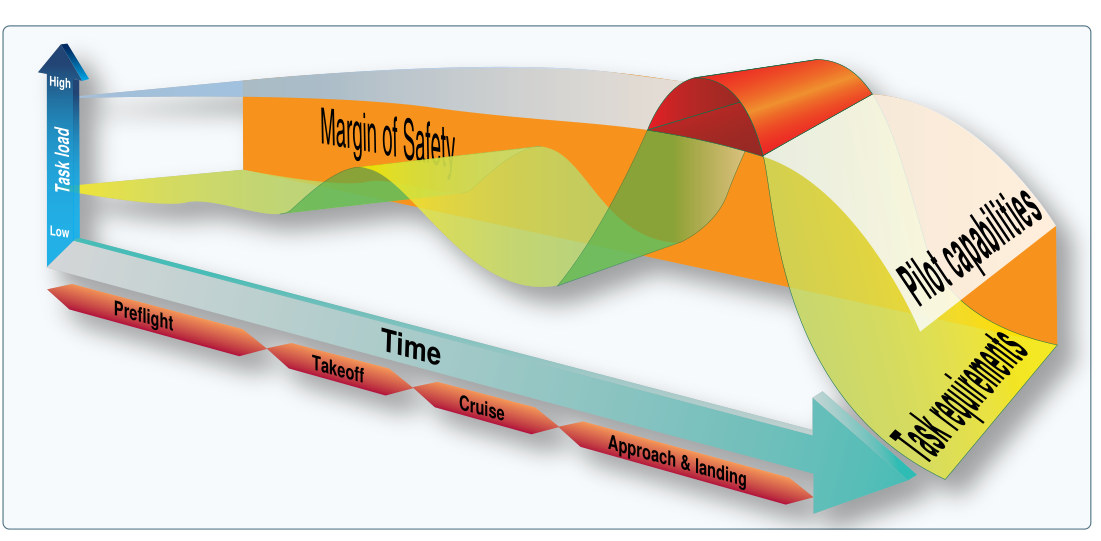
Single-pilot resource management (SRM) is the art of managing every resource available to a solo pilot, both inside and outside the aircraft. It bundles together ADM, risk management, task and workload management, automation management, situational awareness, and terrain awareness — in effect letting one person do the job that a crew normally shares. A key piece is workload management: recognizing when tasks are stacking up and prioritizing so you are not saturated during a critical phase. That means planning and briefing ahead of busy moments, staying ahead of the airplane, and deferring or offloading anything non-essential; task saturation, when demands exceed your capacity, is a signal that something must be dropped. Underlying all of it is situational awareness — an accurate picture of the aircraft, the environment, and your own state, plus a projection of how they will change. Awareness is lost through fixation, fatigue, distraction, and complacency, and its loss is an early link in the accident chain, so noticing when your picture has gone fuzzy and rebuilding it is a core airmanship skill.
Key terms
- SRM
- Single-pilot resource management — managing all resources available to a solo pilot.
- Task saturation
- When task demands exceed the pilot’s capacity to handle them.
- Situational awareness
- An accurate perception of the flight’s factors and how they will change.
Sources & references · 3 · 3 linked
Every claim traces to a source — paraphrased knowledge elements pointing at the governing FAA publication. Items marked verified have been checked against the retrieved source text; the rest are pending verification. Where the exact page or regulation has been located in a retrieved document, the source links straight to it.
- Risk Management Handbook / single-pilot resource management — Risk Management Handbook verifiedFAA-H-8083-2A (p. 56)
- Risk Management Handbook / workload management — Risk Management Handbook verifiedFAA-H-8083-2A (p. 59)
- PHAK Ch. 2 / situational awareness — Pilot’s Handbook of Aeronautical Knowledge verifiedPHAK Ch. 2 (p. 40)
Community
Ask for more detail or suggest additions to make this lesson better. Community input — not authoritative and not CFI-reviewed.
Sign in or create a free account to join the conversation.
No comments yet — be the first to help improve this lesson.