VFR · Lesson 30 · 9 min · ACS PA.III.A · ACS PA.III.B
Beacons, Lighting and Glideslope Aids
Reviewed by a panel of three CFIs + AI review
Summary
White-green beacon = lighted civilian land airport; a daytime beacon warns of below-VFR weather in the surface area. Runway lights white, taxiway lights blue. VASI: red over white is on path; PAPI: two white / two red is on path.
Also watch
Quick check ▾
One question on what you just read.
Question 1 of 1
Airport rotating beacon · Topic mastery: Not started
Exit0 of 1 answered
A rotating beacon alternating white and green indicates what type of airport?
Why this matters in flight
At night or in poor visibility, lights are how you find the airport, tell a runway from a taxiway, and judge whether you are high or low on the approach. Misreading them can put you into terrain or onto the wrong surface.
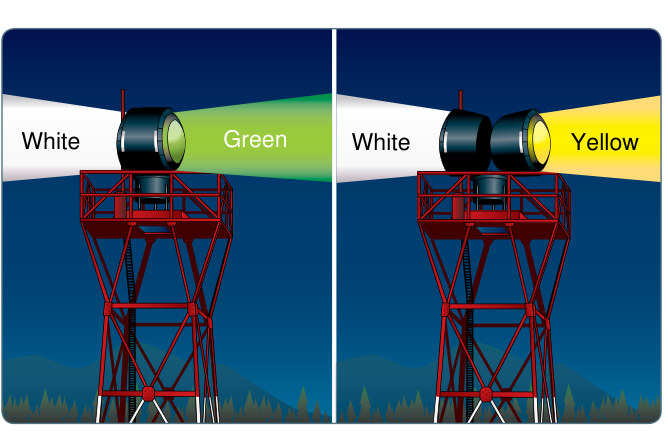
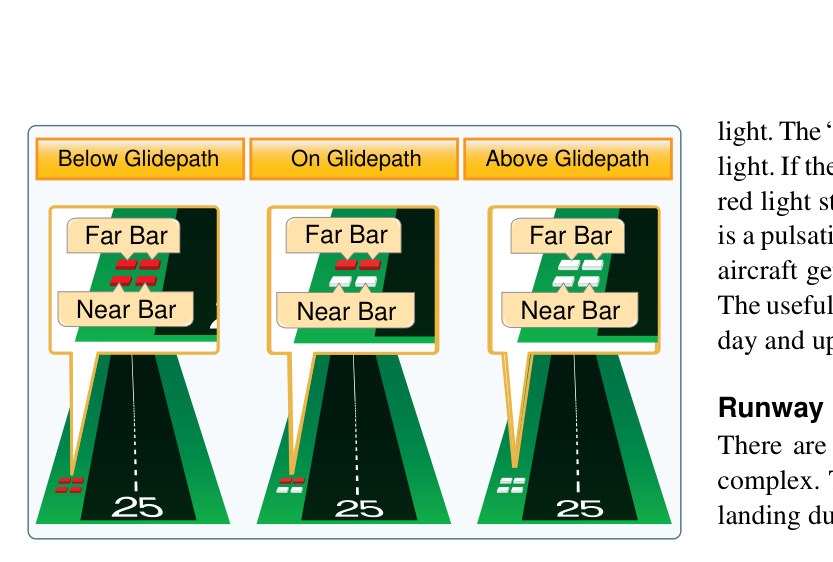
A rotating beacon marks an airport when it is dark or visibility is low. Alternating white and green flashes mean a lighted civilian land airport; white and yellow means a water airport; and two whites plus a green means military. A subtle but important rule: a rotating beacon operating during daylight hours normally indicates that the weather in the Class B, C, D, or E surface area is below basic VFR minimums — a ceiling less than 1,000 feet and/or visibility less than 3 miles — but this is not a substitute for obtaining an actual weather report or checking the weather yourself. Lighting is color-coded too: runway edge lights are white, taxiway edge lights are blue, taxiway centerline lights are green, and runway end lights read green on approach and red from the far end. Finally, visual glideslope aids keep you on a safe descent. A VASI shows "red over white, you are all right," red over red when too low, and white over white when too high. A PAPI is a single horizontal row of four lights that shows four red when low, four white when high, and two white / two red when on the glidepath.
Key terms
- Rotating beacon
- White-and-green flashes mark a lighted civilian land airport.
- VASI
- Two-bar visual aid: red over white is on the glide path.
- PAPI
- A single horizontal row of four lights: two white and two red means on path.
Sources & references · 3 · 3 linked
Every claim traces to a source — paraphrased knowledge elements pointing at the governing FAA publication. Items marked verified have been checked against the retrieved source text; the rest are pending verification. Where the exact page or regulation has been located in a retrieved document, the source links straight to it.
- AIM 2-1-9 — Aeronautical Information Manual verifiedAIM 2-1-9 (p. 41)
- AIM 2-1 — Aeronautical Information Manual verifiedAIM 2-1 (p. 109)
- AIM 2-1-2 — Aeronautical Information Manual verifiedAIM 2-1-2 (p. 41)
Community
Ask for more detail or suggest additions to make this lesson better. Community input — not authoritative and not CFI-reviewed.
Sign in or create a free account to join the conversation.
No comments yet — be the first to help improve this lesson.