VFR · Lesson 31 · 9 min · ACS PA.III.A · ACS PA.III.B
Traffic Patterns and Airport Operations
Reviewed by a panel of three CFIs + AI review
Summary
Standard patterns are left-hand at 1,000 feet AGL. Towered airports require ATC instructions; non-towered airports use CTAF self-announcing. LAHSO is accepted only when a safe stop is assured and may be declined.
Also watch
Quick check ▾
One question on what you just read.
Question 1 of 1
Controlled vs non-towered operations · Topic mastery: Not started
Exit0 of 1 answered
At a non-towered airport, how do pilots coordinate with one another?
Why this matters in flight
The traffic pattern is how airplanes sequence themselves safely to land, and whether an airport has a tower changes who is responsible for that sequencing. Knowing the difference — and how LAHSO works — keeps you predictable to everyone else in the pattern.
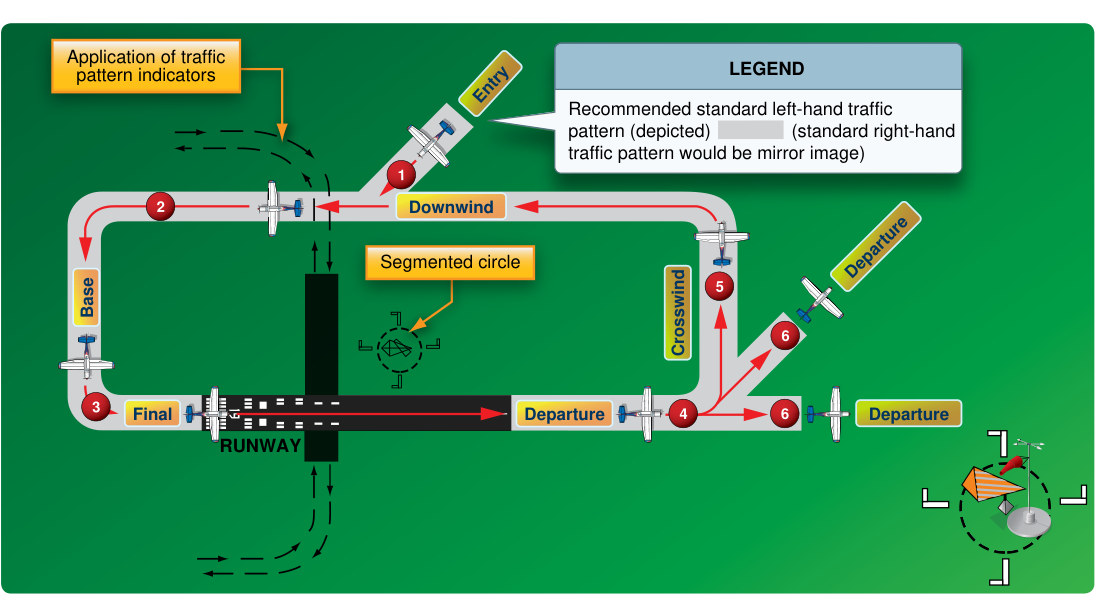
A standard traffic pattern uses left turns and is flown as upwind, crosswind, downwind, base, and final, usually at 1,000 feet above the airport. Some fields use right-hand patterns, shown by the segmented circle or the Chart Supplement, so you confirm the direction before arriving. Where the airport differs is control. At a tower-controlled airport you talk to a controller and follow instructions to taxi, take off, and land. At a non-towered airport there is no controller: pilots self-announce on the CTAF and use standard procedures to fit themselves into the flow, and a UNICOM operator may offer advisories but not control instructions. Land and hold short operations, or LAHSO, ask you to land and stop before an intersecting runway or point to keep traffic separated. You accept only if you are sure you can stop within the published available landing distance, and you may always decline; student pilots are generally advised not to accept LAHSO.
Key terms
- Traffic pattern
- Upwind, crosswind, downwind, base, and final; standard turns are to the left.
- CTAF
- Common traffic advisory frequency used to self-announce at non-towered airports.
- LAHSO
- Land and hold short operations; land and stop before an intersecting point.
Sources & references · 3 · 3 linked
Every claim traces to a source — paraphrased knowledge elements pointing at the governing FAA publication. Items marked verified have been checked against the retrieved source text; the rest are pending verification. Where the exact page or regulation has been located in a retrieved document, the source links straight to it.
- FAA-H-8083-25 (traffic pattern) — Pilot’s Handbook of Aeronautical Knowledge verifiedPilot’s Handbook (document)
- AIM 4-1 / 4-3 — Aeronautical Information Manual verifiedAIM 4-1 (p. 199)
- AIM 4-3-11 — Aeronautical Information Manual verifiedAIM 4-3-11 (p. 44)
Community
Ask for more detail or suggest additions to make this lesson better. Community input — not authoritative and not CFI-reviewed.
Sign in or create a free account to join the conversation.
No comments yet — be the first to help improve this lesson.