VFR · Lesson 32 · 6 min · ACS PA.I.E
The Airspace System at a Glance
Reviewed by a panel of three CFIs + AI review
Summary
Controlled airspace is Classes A–E; uncontrolled airspace is Class G. VFR private pilots mostly operate in E and G and transit B/C/D near busy airports.
Also watch
Quick check ▾
One question on what you just read.
Question 1 of 1
Class A airspace and IFR-only operations · Topic mastery: Not started
Exit0 of 1 answered
Class A airspace generally begins at which altitude?
Why this matters in flight
Knowing which airspace you are in tells you who you must talk to, what equipment you need, and what weather you legally need to fly. Getting this wrong can put you into airspace you are not cleared for.
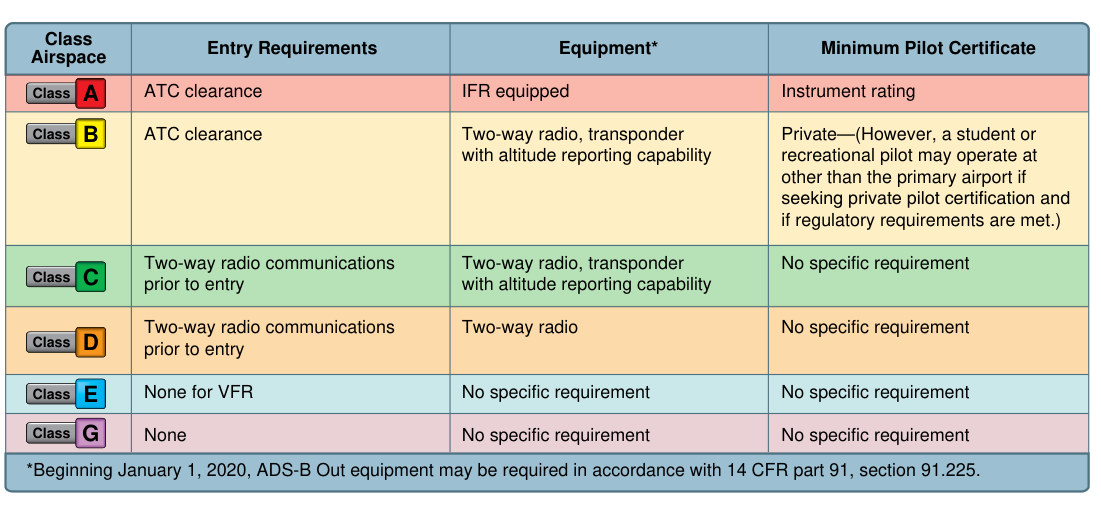
US airspace is divided into controlled and uncontrolled airspace. Controlled airspace is where air traffic control can provide separation and services; it is labeled Classes A, B, C, D, and E. Uncontrolled airspace is Class G. A simple way to remember the controlled classes is that they run from the most restrictive (Class A, high altitude, instrument flight only) down to the least restrictive controlled class (Class E). Class G sits underneath, closest to the ground, where ATC does not separate traffic and you are responsible for seeing and avoiding other aircraft. As a VFR private pilot you will spend most of your time in Classes E and G, occasionally transiting B, C, or D near busier airports. Where Class E BEGINS is a favorite chart question, and the sectional depicts it exactly: a dashed magenta line encloses Class E that starts at the SURFACE (protecting an instrument approach at an airport); inside a shaded MAGENTA vignette, Class E starts at 700 feet AGL; outside the magenta shading — including areas bounded by shaded BLUE vignette — Class E starts at 1,200 feet AGL; and unless otherwise depicted, Class E also exists at and above 14,500 feet MSL. Class G fills the space below whichever Class E floor applies. Read the floors from the shading, not from memory of one airport.
Key terms
- Controlled airspace
- Airspace where ATC service is available: Classes A, B, C, D, E.
- Uncontrolled airspace
- Class G, where ATC does not separate traffic.
- MSL / AGL
- Altitude above mean sea level versus above ground level.
- Magenta vignette
- Shaded magenta on a sectional: Class E begins at 700 feet AGL inside it; dashed magenta means Class E to the surface.
Sources & references · 3 · 6 linked
Every claim traces to a source — paraphrased knowledge elements pointing at the governing FAA publication. Items marked verified have been checked against the retrieved source text; the rest are pending verification. Where the exact page or regulation has been located in a retrieved document, the source links straight to it.
- 14 CFR 71 / AIM 3-2-2 — 14 CFR Part 71 — Designation of Airspace verified14 CFR Part 71AIM 3-2-2 (p. 42)
- AIM 3-2-6 / 14 CFR 71 — Aeronautical Information Manual verified14 CFR Part 71AIM 3-2-6 (p. 42)
- AIM 3-3-1 / 14 CFR 91.155 — Aeronautical Information Manual verified14 CFR 91.155AIM 3-3-1 (p. 42)
Community
Ask for more detail or suggest additions to make this lesson better. Community input — not authoritative and not CFI-reviewed.
Sign in or create a free account to join the conversation.
No comments yet — be the first to help improve this lesson.