VFR · Lesson 19 · 9 min · ACS PA.I.G · ACS PA.VIII
The Pitot-Static Instruments and Their Failures
Reviewed by a panel of three CFIs + AI review
Summary
The pitot feeds only the airspeed indicator while the static port feeds all three pitot-static instruments; a blocked static port freezes the altimeter and VSI and skews airspeed, and the altimeter must be set for local pressure to avoid a dangerous over-read from high to low.
Also watch
Quick check ▾
One question on what you just read.
Question 1 of 1
Airspeed indicator and blockages · Topic mastery: Not started
Exit0 of 1 answered
If the pitot tube’s ram inlet becomes blocked but its drain hole remains open, what happens to the airspeed indicator?
Why this matters in flight
Three of your most-used instruments share one air system, so a single blocked port can quietly corrupt them all. Understanding the plumbing lets you recognize a failure and switch to the alternate static source instead of trusting a lie.
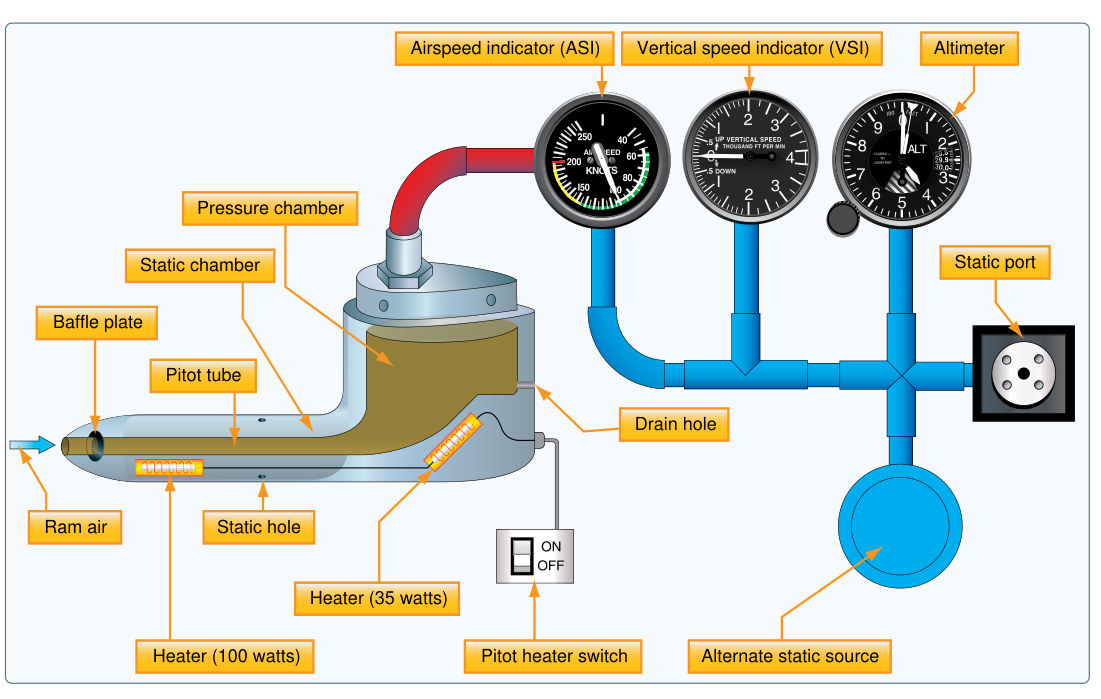
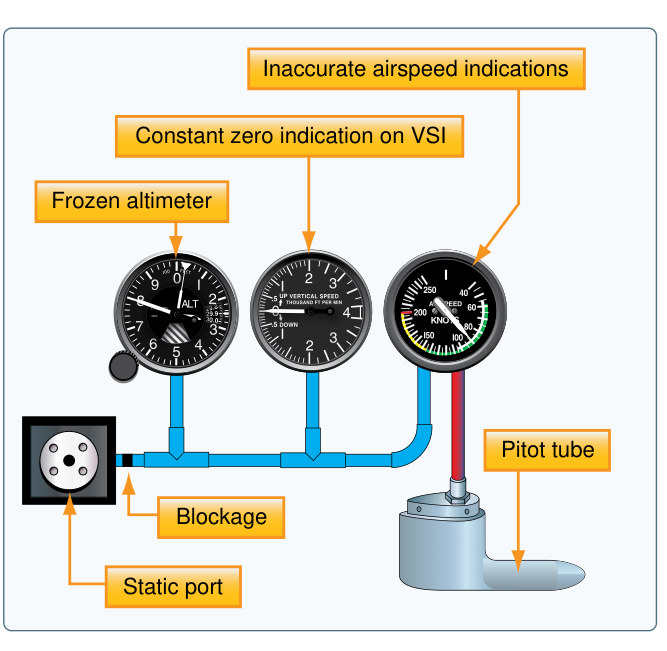
The pitot-static system feeds the airspeed indicator, the altimeter, and the vertical speed indicator. The pitot tube captures ram air pressure and feeds only the airspeed indicator, while the static port senses ambient pressure and feeds all three instruments. The airspeed indicator compares ram and static pressure and displays speed on color arcs: white for the flap range, green for normal operation, yellow as a caution range for smooth air, and a red line at the never-exceed speed. Blockages are predictable. If the pitot ram inlet clogs but the drain stays open, airspeed falls toward zero; if both the inlet and drain block, the airspeed indicator acts like an altimeter, rising with altitude. A blocked static port makes airspeed inaccurate, freezes the altimeter, and disables the VSI — the reason an alternate static source exists. The altimeter measures static pressure and needs the current setting in its Kollsman window, remembering that flying from high to low pressure without resetting means "look out below." The VSI shows the rate of climb or descent with a slight lag because it senses how fast static pressure is changing.
Key terms
- Pitot tube
- The inlet that captures ram air pressure for the airspeed indicator.
- Static port
- The port sensing ambient pressure for the ASI, altimeter, and VSI.
- Kollsman window
- The altimeter window where the current altimeter setting is entered.
Sources & references · 4 · 4 linked
Every claim traces to a source — paraphrased knowledge elements pointing at the governing FAA publication. Items marked verified have been checked against the retrieved source text; the rest are pending verification. Where the exact page or regulation has been located in a retrieved document, the source links straight to it.
- PHAK Ch. 8 — Pilot’s Handbook of Aeronautical Knowledge verifiedPHAK Ch. 8 (p. 203)
- PHAK Ch. 8 — Pilot’s Handbook of Aeronautical Knowledge verifiedPHAK Ch. 8 (p. 203)
- PHAK Ch. 8 — Pilot’s Handbook of Aeronautical Knowledge verifiedPHAK Ch. 8 (p. 203)
- PHAK Ch. 8 — Pilot’s Handbook of Aeronautical Knowledge verifiedPHAK Ch. 8 (p. 203)
Community
Ask for more detail or suggest additions to make this lesson better. Community input — not authoritative and not CFI-reviewed.
Sign in or create a free account to join the conversation.
No comments yet — be the first to help improve this lesson.