VFR · Lesson 50 · 10 min · ACS PA.VI · ACS PA.V
Direction: True, Magnetic, Wind and Compass Errors
Reviewed by a panel of three CFIs + AI review
Summary
Convert true course to magnetic with variation, refine with deviation, correct for wind with a wind correction angle, and account for compass acceleration and turning errors (ANDS).
Also watch
Quick check ▾
One question on what you just read.
Question 1 of 1
Magnetic versus true direction · Topic mastery: Not started
Exit0 of 1 answered
What is magnetic variation?
Why this matters in flight
The heading you fly is rarely the course you drew on the chart. Variation, wind, and compass errors each nudge the number, and getting from a true course to a compass heading you can actually fly is the heart of practical navigation.
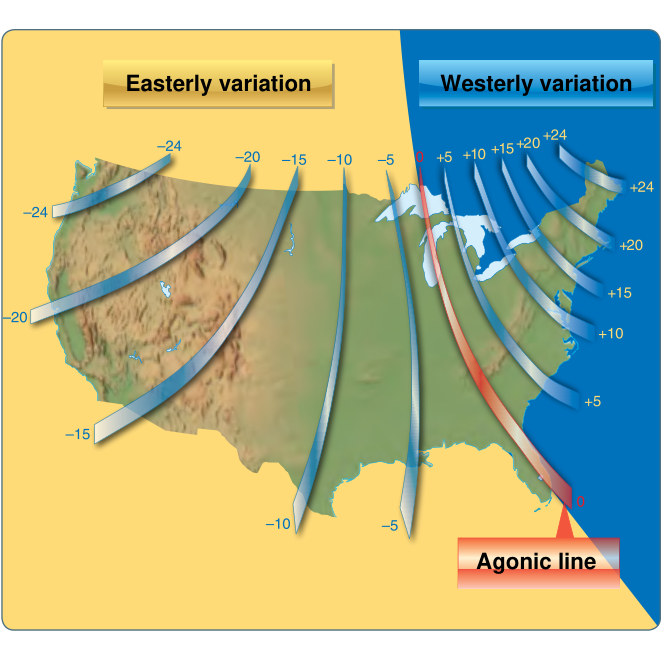
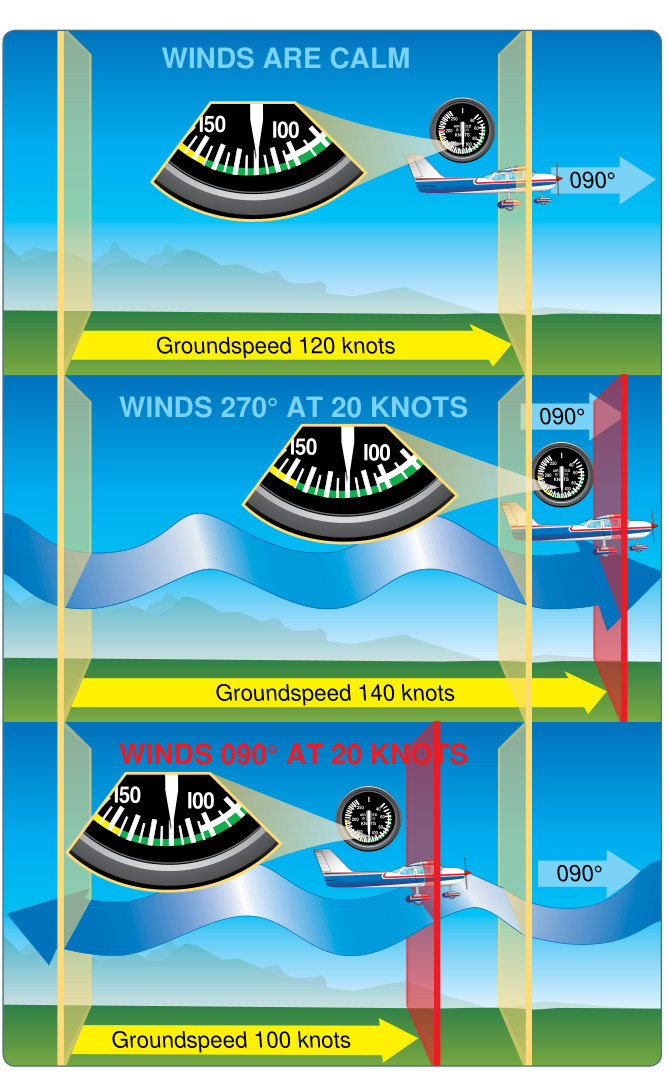
Charts are drawn to true north, but your compass points to magnetic north, so you must convert. The angular difference at your location is magnetic variation, shown by isogonic lines: add westerly variation to, or subtract easterly variation from, the true course to get the magnetic course. A further small error, deviation, comes from magnetic influences within the airplane and is corrected with the compass correction card. Wind adds another adjustment: because a crosswind pushes you off course, you turn slightly into it by a wind correction angle so your actual track matches the desired course, and the wind triangle also gives the resulting groundspeed — lower into a headwind, higher with a tailwind. Finally, the magnetic compass itself misbehaves during acceleration and in turns: remember ANDS (Accelerate North, Decelerate South), and expect the compass to lag near north and lead near south. It is trustworthy only in straight-and-level, unaccelerated flight. Work the conversion chain as a formula and drill it: true course, plus or minus variation, gives magnetic course ("east is least, west is best" — subtract easterly, add westerly); magnetic course corrected for deviation gives compass course; the reverse path undoes each step in order. Time questions use the same discipline: convert local time to Zulu by adding the zone offset (for example 0900 Central Standard Time + 6 hours = 1500Z), and remember every aviation product — METARs, TAFs, flight plans — runs on Zulu, so a mistake here shifts every other answer.
Key terms
- Variation
- The angular difference between true and magnetic north at a location.
- Deviation
- Compass error from magnetic fields within the airplane.
- Wind correction angle
- The angle into the wind flown so track matches the desired course.
Sources & references · 3 · 3 linked
Every claim traces to a source — paraphrased knowledge elements pointing at the governing FAA publication. Items marked verified have been checked against the retrieved source text; the rest are pending verification. Where the exact page or regulation has been located in a retrieved document, the source links straight to it.
- PHAK Ch. 16 — Pilot’s Handbook of Aeronautical Knowledge verifiedPHAK Ch. 16 (p. 388)
- PHAK Ch. 16 — Pilot’s Handbook of Aeronautical Knowledge verifiedPHAK Ch. 16 (p. 388)
- PHAK Ch. 16 — Pilot’s Handbook of Aeronautical Knowledge verifiedPHAK Ch. 16 (p. 388)
Community
Ask for more detail or suggest additions to make this lesson better. Community input — not authoritative and not CFI-reviewed.
Sign in or create a free account to join the conversation.
No comments yet — be the first to help improve this lesson.