VFR · Lesson 8 · 7 min · ACS PA.I.A · ACS PA.I.B
Right-of-Way Rules and Dropping Objects
Reviewed by a panel of three CFIs + AI review
Summary
Distress traffic has priority, converging same-category aircraft yield to the one on the right, head-on traffic both turn right, and the overtaken aircraft has priority; objects may not be dropped in a way that creates a hazard without reasonable precautions.
Also watch
Quick check ▾
One question on what you just read.
Question 1 of 1
Right-of-way rules (91.113) · Topic mastery: Not started
Exit0 of 1 answered
Which aircraft has the right of way over all other air traffic?
Why this matters in flight
When two aircraft meet, the right-of-way rules decide who yields, and hesitation or a wrong assumption can lead to a collision. Knowing the priorities lets you act predictably and see-and-avoid effectively.
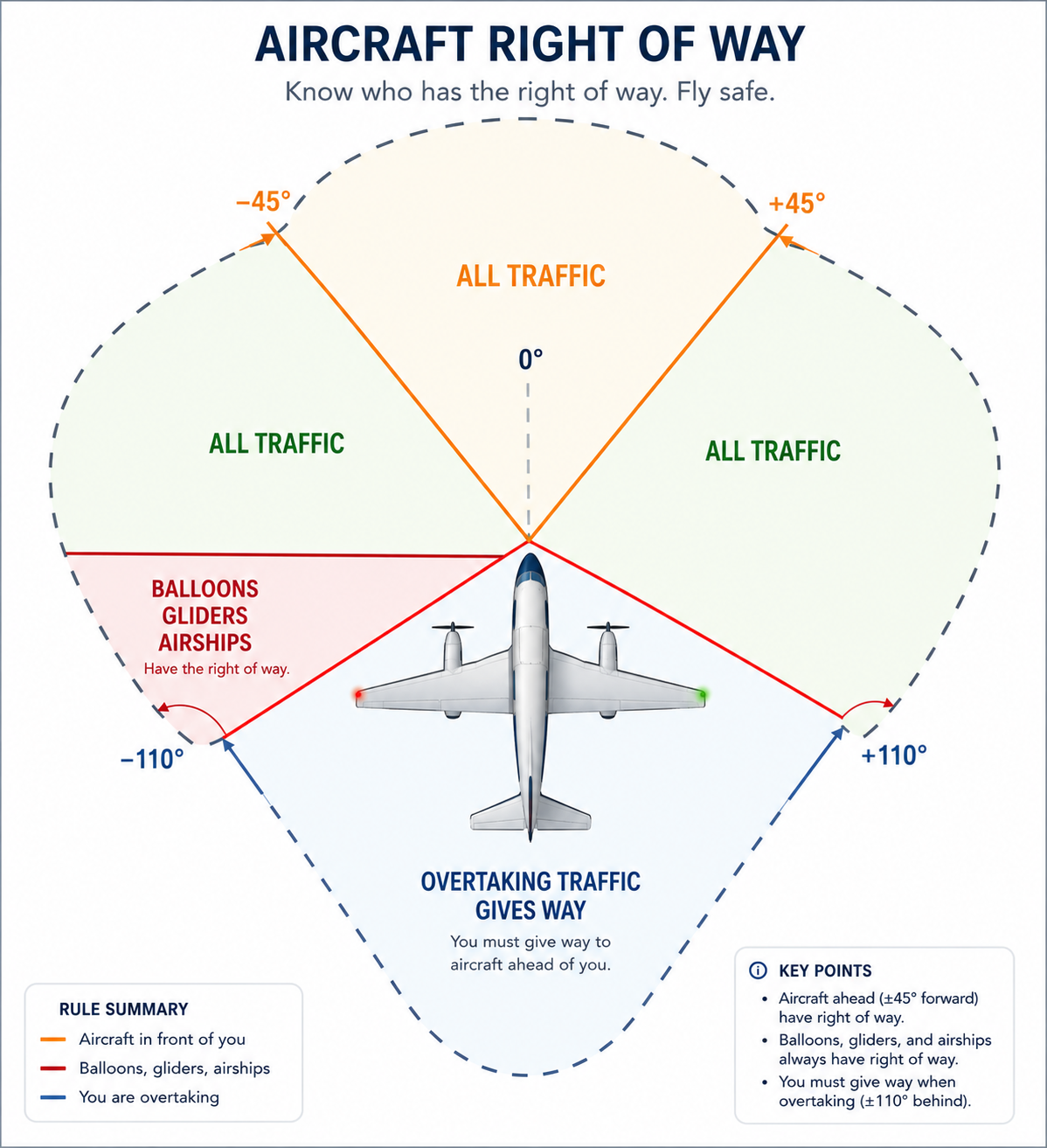
The right-of-way rules create a predictable order for who yields. An aircraft in distress has the right of way over all other traffic, because an emergency takes priority. When two aircraft of the same category are converging, the one to the other’s right has the right of way — a rule similar to yielding to the vehicle on your right. When aircraft of DIFFERENT categories converge, the less maneuverable aircraft generally has priority: a balloon has the right of way over any other category; a glider has the right of way over an airship, powered parachute, weight-shift-control aircraft, airplane, or rotorcraft; and an airship has the right of way over the powered aircraft below it in that list. Regardless of category, an aircraft towing or refueling another aircraft has the right of way over all other engine-driven aircraft. When aircraft approach head-on, both pilots turn right to pass. An aircraft being overtaken has the right of way, and the faster aircraft passes well clear to the right. Landing traffic has its own rule: an aircraft on final approach to land, or while landing, has the right of way over other aircraft in flight or on the surface — and when two or more aircraft approach an airport to land, the aircraft at the LOWER altitude has the right of way, though it may not use that rule to cut in front of or overtake another on final. None of these priorities relieves any pilot of the duty to see and avoid other aircraft. A related rule addresses dropping objects: a pilot in command may not allow any object to be dropped in flight that creates a hazard to persons or property, but dropping is allowed if reasonable precautions are taken to prevent injury or damage. Together these rules keep pilots from creating hazards for others in the air or on the ground.
Key terms
- Converging
- Two aircraft on paths that would intersect; the one on the right has priority.
- Overtaking
- Approaching another aircraft from behind; the overtaken aircraft has the right of way.
- See and avoid
- The pilot’s ongoing duty to watch for and avoid other aircraft.
Sources & references · 2 · 2 linked
Every claim traces to a source — paraphrased knowledge elements pointing at the governing FAA publication. Items marked verified have been checked against the retrieved source text; the rest are pending verification. Where the exact page or regulation has been located in a retrieved document, the source links straight to it.
- 14 CFR 91.113 — 14 CFR Part 91 — General Operating and Flight Rules verified14 CFR 91.113
- 14 CFR 91.15 — 14 CFR Part 91 — General Operating and Flight Rules verified14 CFR 91.15
Community
Ask for more detail or suggest additions to make this lesson better. Community input — not authoritative and not CFI-reviewed.
Sign in or create a free account to join the conversation.
No comments yet — be the first to help improve this lesson.