VFR · Lesson 15 · 7 min · ACS PA.I.G
Airframe and the Four-Stroke Engine
Reviewed by a panel of three CFIs + AI review
Summary
The airframe comprises the fuselage, wings, empennage, landing gear, and powerplant, with the elevator controlling pitch and rudder controlling yaw; the four-stroke engine repeats intake, compression, power, and exhaust in each cylinder.
Also watch
Quick check ▾
One question on what you just read.
Question 1 of 1
Airframe and empennage · Topic mastery: Not started
Exit0 of 1 answered
Which control surface on the empennage controls the airplane’s pitch?
Why this matters in flight
You cannot make good decisions about a machine you do not understand. Knowing the parts of the airframe and how the engine turns fuel into thrust helps you preflight intelligently and recognize when something is not right.
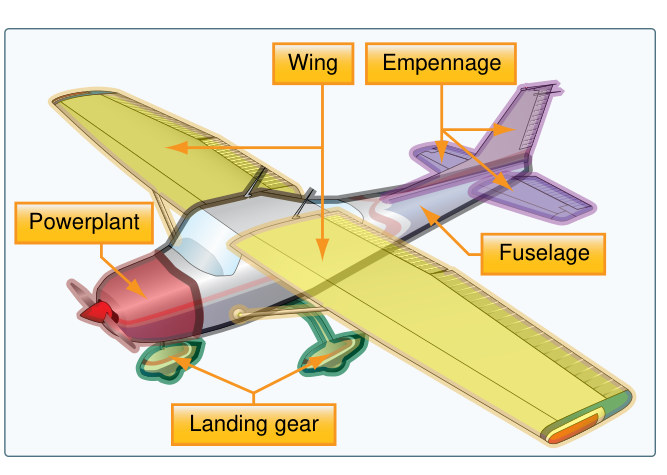
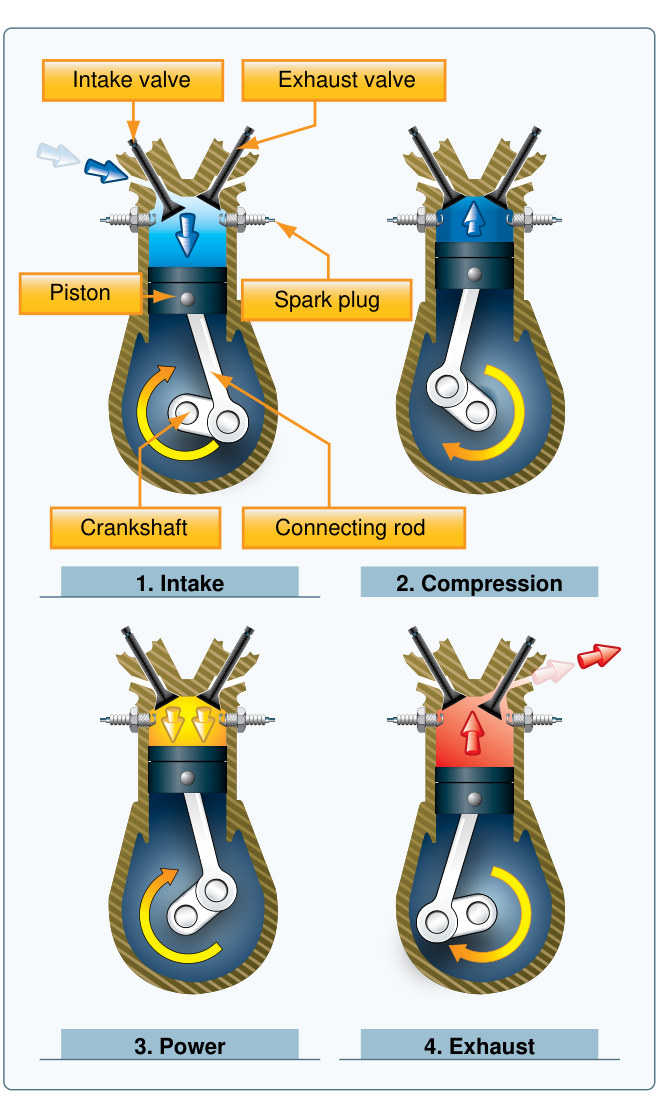
A training airplane breaks down into a handful of major structures: the fuselage that carries the cabin and connects everything, the wings that produce lift, the empennage or tail section, the landing gear, and the powerplant. The empennage is worth knowing in detail because it houses two primary controls: the horizontal stabilizer and its elevator control pitch, while the vertical stabilizer and its rudder control yaw. Small trim tabs relieve the control pressures the pilot would otherwise hold. The engine that drives most trainers is a four-stroke reciprocating engine. In each cylinder a piston repeats four strokes: intake draws in the fuel/air mixture, compression squeezes it, a spark ignites it to produce the power stroke that turns the crankshaft, and exhaust pushes the burned gases out. Remembering "intake, compression, power, exhaust" keeps the cycle straight, and understanding that only the power stroke produces useful work explains why smooth combustion matters so much. The engine turns a propeller, which is how that power becomes thrust. Many trainers use a fixed-pitch propeller, where the blade angle never changes and engine RPM on the tachometer is your only power setting. More capable airplanes use a constant-speed propeller: a governor automatically changes blade pitch to hold the RPM you select with a separate propeller control, while the throttle sets manifold pressure. With that two-lever setup you add power by advancing the propeller control (RPM) before the throttle (manifold pressure) and reduce power in the reverse order, which keeps you from running high manifold pressure against low RPM.
Key terms
- Empennage
- The tail section, including the horizontal and vertical stabilizers and their control surfaces.
- Elevator
- The movable surface on the horizontal stabilizer that controls pitch.
- Four-stroke cycle
- The intake, compression, power, and exhaust strokes of a reciprocating engine.
- Constant-speed propeller
- A propeller whose governor varies blade pitch to hold a selected RPM; throttle sets manifold pressure and the propeller control sets RPM.
- Manifold pressure
- The pressure in the intake manifold, set by the throttle, and the primary power reference on a constant-speed-propeller engine.
Sources & references · 3 · 3 linked
Every claim traces to a source — paraphrased knowledge elements pointing at the governing FAA publication. Items marked verified have been checked against the retrieved source text; the rest are pending verification. Where the exact page or regulation has been located in a retrieved document, the source links straight to it.
- PHAK Ch. 6 — Pilot’s Handbook of Aeronautical Knowledge verifiedPHAK Ch. 6 (p. 149)
- PHAK Ch. 7 — Pilot’s Handbook of Aeronautical Knowledge verifiedPHAK Ch. 7 (p. 161)
- PHAK Ch. 7 — Pilot’s Handbook of Aeronautical Knowledge verifiedPHAK Ch. 7 (p. 161)
Community
Ask for more detail or suggest additions to make this lesson better. Community input — not authoritative and not CFI-reviewed.
Sign in or create a free account to join the conversation.
No comments yet — be the first to help improve this lesson.