VFR · Lesson 16 · 8 min · ACS PA.I.G
Ignition, Induction and Carburetor Ice
Reviewed by a panel of three CFIs + AI review
Summary
Dual magnetos provide redundant, battery-independent ignition checked during run-up; carburetors mix fuel and air but ice more readily than fuel injection, and carburetor heat is the remedy for induction ice that can form even on warm, humid days.
Also watch
Quick check ▾
One question on what you just read.
Question 1 of 1
Ignition system and magnetos · Topic mastery: Not started
Exit0 of 1 answered
During the run-up magneto check, what indication is normal when switching from BOTH to a single magneto?
Why this matters in flight
The magneto check and the way you manage induction icing are day-one skills. Knowing why the engine has two ignition systems and how carburetor ice sneaks up on you can prevent a partial power loss from becoming an emergency.
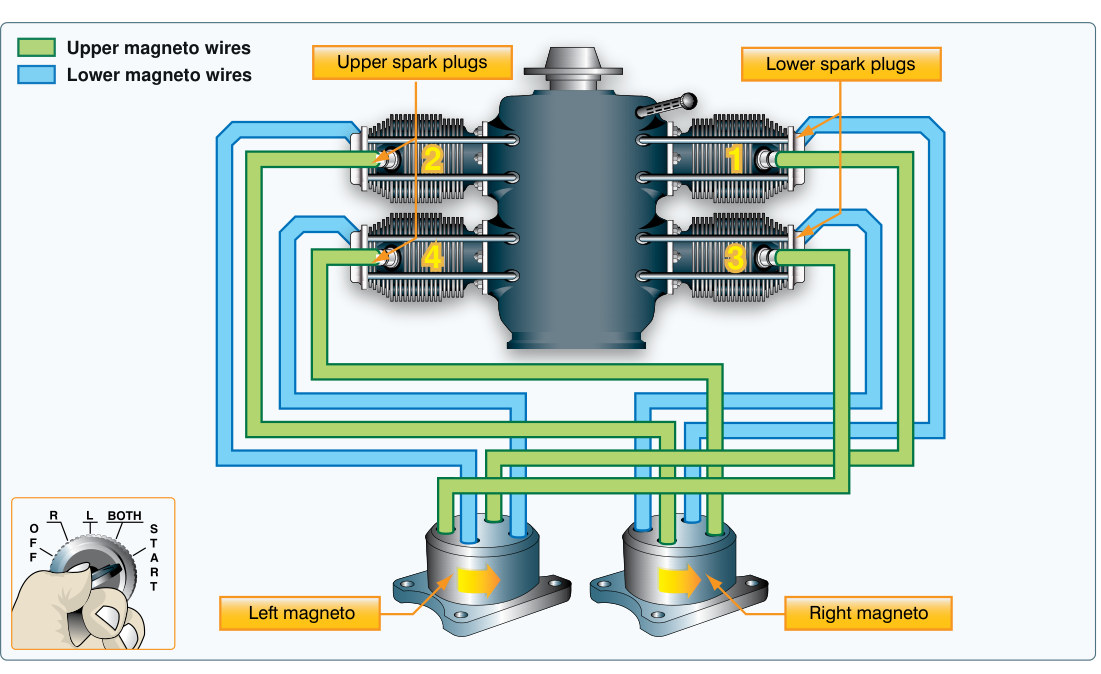
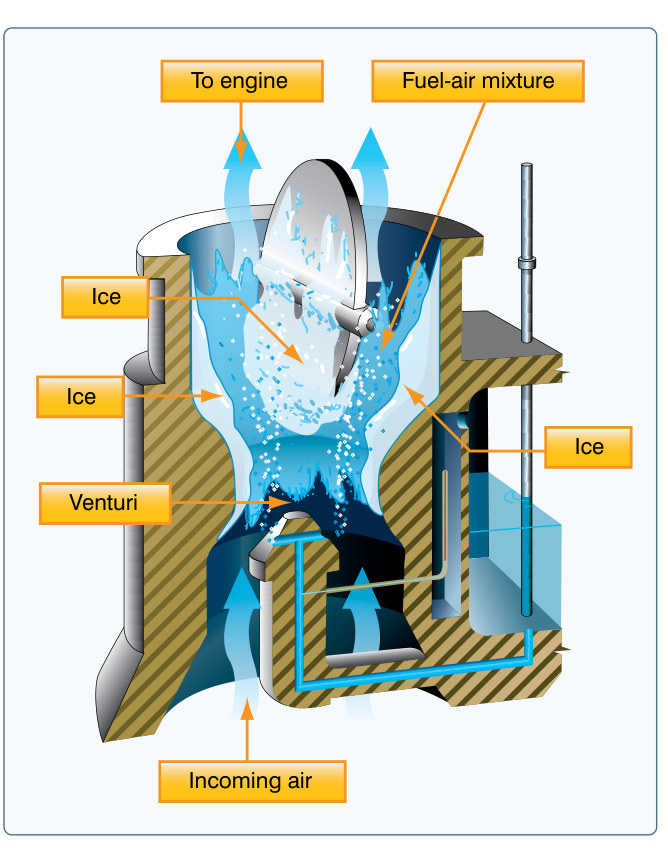
Aircraft piston engines use dual ignition: two independent, engine-driven magnetos, each firing one of the two spark plugs in every cylinder. Because a magneto generates its own spark, the engine keeps running even with a dead battery, and the second magneto is a built-in backup that also improves combustion. During run-up you check each magneto alone and expect a small RPM drop; too large a drop or none at all points to a problem. Air and fuel reach the cylinders through the induction system. A float-type carburetor mixes fuel and air using a venturi, which is simple and cheap but prone to icing. Fuel injection instead sprays fuel at each intake port, giving more even distribution, better performance, and far less icing risk. Carburetor ice is a special hazard: the pressure drop and fuel vaporization in the venturi cool the air, and moisture can freeze even on a warm, humid day, choking the mixture. The test asks for the specifics: float-type carburetors are markedly more susceptible than fuel-injected engines, the risk is highest at outside air temperatures of roughly 20 to 70 degrees Fahrenheit with high humidity or visible moisture, and in an airplane with a fixed-pitch propeller the FIRST indication of carburetor ice is a decrease in engine RPM (with a constant-speed propeller it shows as a drop in manifold pressure). Carburetor heat melts and prevents the ice, though it reduces power and enriches the mixture — expect a further small RPM drop when heat is first applied, then a rise as the ice melts — so a gradual RPM loss and rough running should prompt its use.
Key terms
- Magneto
- A self-contained, engine-driven device that generates ignition spark without the battery.
- Venturi
- A narrowed passage where accelerating air drops in pressure and draws fuel in a carburetor.
- Carburetor heat
- Warm air routed to the carburetor to melt or prevent induction ice.
Sources & references · 4 · 4 linked
Every claim traces to a source — paraphrased knowledge elements pointing at the governing FAA publication. Items marked verified have been checked against the retrieved source text; the rest are pending verification. Where the exact page or regulation has been located in a retrieved document, the source links straight to it.
- PHAK Ch. 7 — Pilot’s Handbook of Aeronautical Knowledge verifiedPHAK Ch. 7 (p. 161)
- PHAK Ch. 7 — Pilot’s Handbook of Aeronautical Knowledge verifiedPHAK Ch. 7 (p. 161)
- PHAK Ch. 7 — Pilot’s Handbook of Aeronautical Knowledge verifiedPHAK Ch. 7 (p. 161)
- PHAK Ch. 7 — Pilot’s Handbook of Aeronautical Knowledge verifiedPHAK Ch. 7 (p. 161)
Community
Ask for more detail or suggest additions to make this lesson better. Community input — not authoritative and not CFI-reviewed.
Sign in or create a free account to join the conversation.
No comments yet — be the first to help improve this lesson.