VFR · Lesson 17 · 8 min · ACS PA.I.G
Mixture, Oil and Fuel
Reviewed by a panel of three CFIs + AI review
Summary
Lean the mixture as you climb to keep the fuel/air ratio correct; monitor oil pressure and temperature for a system that lubricates, cools, cleans, seals, and cushions; and confirm the correct fuel by grade and color, keeping jet fuel out of piston engines.
Also watch
Quick check ▾
One question on what you just read.
Question 1 of 1
Mixture control and leaning · Topic mastery: Not started
Exit0 of 1 answered
Why must a pilot lean the mixture as the airplane climbs to higher altitude?
Why this matters in flight
Leaning the mixture, watching the oil gauges, and confirming the right fuel are routine but consequential. Getting any of them wrong can rob power, overheat the engine, or cause a failure far from a runway.
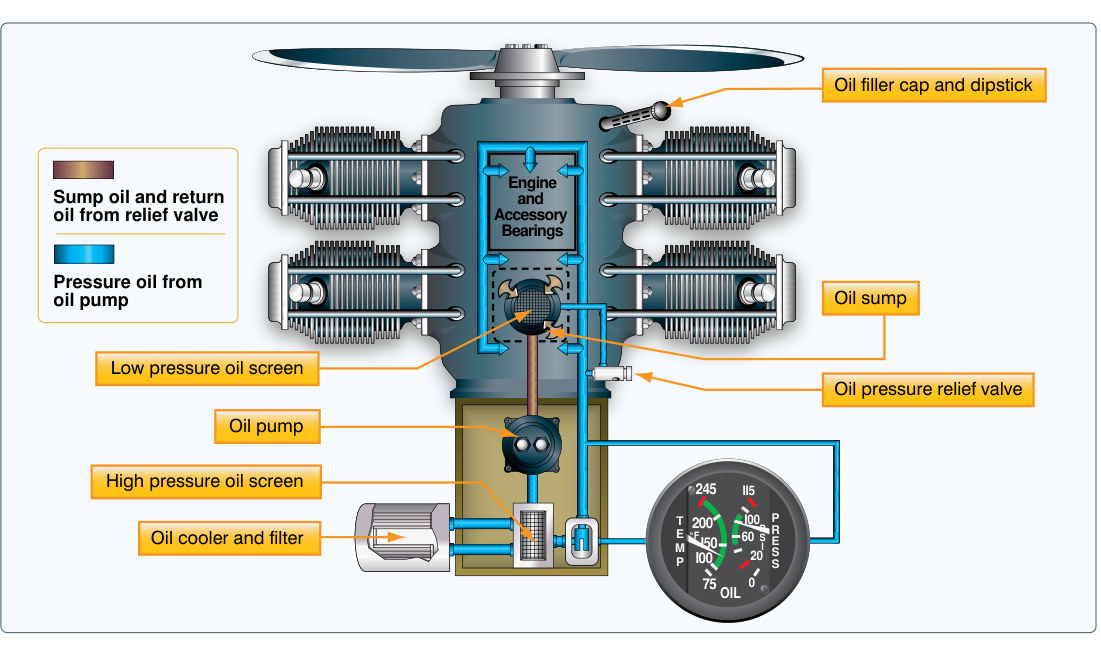
Three engine housekeeping systems deserve attention on every flight. The mixture control sets the ratio of fuel to air. Because air thins with altitude, a mixture set for sea level runs too rich as you climb, so leaning removes the excess fuel to restore efficiency and prevent spark plug fouling; pilots use full rich for takeoff at low elevations and lean per the flight manual. The oil system does more than lubricate: it also cools, cleans, seals, and cushions, and the pilot judges its health from the oil pressure and oil temperature gauges. Fuel matters just as much. Aviation gasoline is color-coded by grade so a pilot can confirm the correct fuel — 100LL is blue, grade 100 is green, and the older grade 80 is red — while turbine jet fuel is clear or straw-colored and must never go into a piston engine. Using the wrong grade or type can damage the engine, which is why sampling and confirming fuel color is part of every preflight. Fuel and mixture also drive two abnormal-combustion hazards. Detonation is the uncontrolled, near-explosive burning of the charge — brought on by too low a fuel grade, an over-lean mixture at high power, or high manifold pressure with low RPM and hot cylinders — and it shows up as high cylinder head temperature, roughness, and power loss. Preignition is different: the mixture lights early off a hot spot such as a glowing deposit before the plug fires. Both overheat the engine and can occur together, and both are countered the same practical way: use the correct fuel grade, keep the mixture appropriate for the power setting, and reduce power or enrich to bring temperatures back down.
Key terms
- Leaning
- Reducing fuel in the mixture as air density decreases with altitude.
- Wet-sump oil system
- A system storing oil in the engine sump, common in training airplanes.
- 100LL
- Low-lead aviation gasoline, dyed blue.
- Detonation
- Uncontrolled explosive burning of the fuel/air charge, often from low-grade fuel or an over-lean, high-power condition.
- Preignition
- Ignition of the mixture before the spark, caused by a hot spot in the cylinder.
Sources & references · 5 · 5 linked
Every claim traces to a source — paraphrased knowledge elements pointing at the governing FAA publication. Items marked verified have been checked against the retrieved source text; the rest are pending verification. Where the exact page or regulation has been located in a retrieved document, the source links straight to it.
- PHAK Ch. 7 — Pilot’s Handbook of Aeronautical Knowledge verifiedPHAK Ch. 7 (p. 161)
- PHAK Ch. 7 (engine oil systems) — Pilot’s Handbook of Aeronautical Knowledge verifiedFAA-H-8083-3C Ch. 2 (p. 38)
- PHAK Ch. 7 — Pilot’s Handbook of Aeronautical Knowledge verifiedPHAK Ch. 7 (p. 161)
- PHAK Ch. 7 — Pilot’s Handbook of Aeronautical Knowledge verifiedPHAK Ch. 7 (p. 161)
- PHAK Ch. 7 — Pilot’s Handbook of Aeronautical Knowledge verifiedPHAK Ch. 7 (p. 161)
Community
Ask for more detail or suggest additions to make this lesson better. Community input — not authoritative and not CFI-reviewed.
Sign in or create a free account to join the conversation.
No comments yet — be the first to help improve this lesson.