VFR · Lesson 24 · 8 min · ACS PA.I.F
Weight and Balance Fundamentals
Reviewed by a panel of three CFIs + AI review
Summary
Empty weight plus useful load equals gross weight; CG is total moment over total weight; a loading is legal only when both weight and CG are within limits, including after fuel burn.
Also watch
Quick check ▾
One question on what you just read.
Question 1 of 1
Weight and balance terminology · Topic mastery: Not started
Exit0 of 1 answered
What does the empty weight of an airplane include?
Why this matters in flight
An airplane loaded outside its limits may be unable to climb, may be uncontrollable, or may exceed its structural strength. Every pilot is legally responsible for confirming the airplane is within weight and CG limits before every flight.
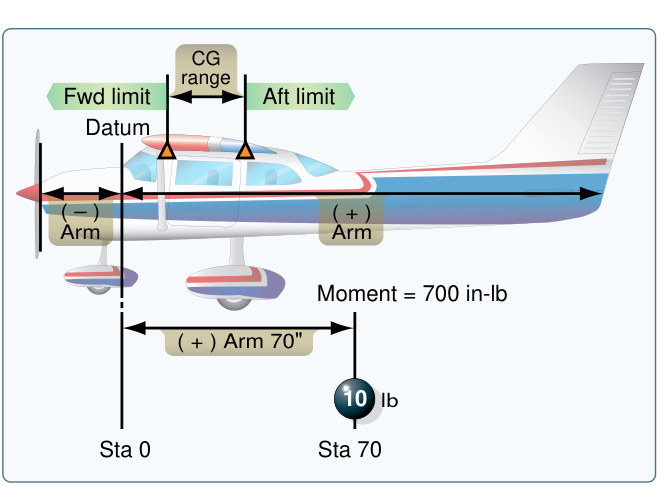
Weight and balance rests on a few terms. The empty weight is the airplane with operating fluids but no people, bags, or usable fuel. The useful load is what is left before hitting maximum gross weight — the pilot, passengers, fuel, and baggage. Where each item sits is measured by its arm, the distance in inches from the reference datum, and the product of weight and arm is the moment. To work a loading problem you list every item with its weight and arm, multiply to get each moment, add up the weights, add up the moments, and divide total moment by total weight to find the center of gravity. A loading is legal only if the total weight is at or below the maximum AND the CG falls between the forward and aft limits. Both tests must pass; an airplane can be light but still nose- or tail-heavy. Because fuel burns off during flight and shifts the CG, a loading that is legal at takeoff must remain legal at landing. The exam works this as arithmetic on Testing Supplement loading graphs and tables: drill the full moment computation, plotting a load on the CG envelope, the effect of moving or adding baggage and of fuel burn on CG position, and how much weight change brings an over-gross loading back to maximum gross. Practice with the FAA loading-graph figures until reading moments off the chart is routine — the questions are calculations, not definitions.
Key terms
- Empty weight
- The airplane with operating fluids but no useful load.
- Useful load
- Maximum gross weight minus empty weight: people, fuel, and baggage.
- Moment
- Weight multiplied by arm; a measure of turning tendency about the datum.
- Center of gravity
- Total moment divided by total weight; the balance point.
Sources & references · 3 · 3 linked
Every claim traces to a source — paraphrased knowledge elements pointing at the governing FAA publication. Items marked verified have been checked against the retrieved source text; the rest are pending verification. Where the exact page or regulation has been located in a retrieved document, the source links straight to it.
- FAA-H-8083-1 Ch. 1 — Aircraft Weight and Balance Handbook verifiedFAA-H-8083-1A Ch. 1 (p. 15)
- FAA-H-8083-1 Ch. 4 — Aircraft Weight and Balance Handbook verifiedFAA-H-8083-1A Ch. 4 (p. 43)
- FAA-H-8083-1 Ch. 4 — Aircraft Weight and Balance Handbook verifiedFAA-H-8083-1A Ch. 4 (p. 43)
Community
Ask for more detail or suggest additions to make this lesson better. Community input — not authoritative and not CFI-reviewed.
Sign in or create a free account to join the conversation.
No comments yet — be the first to help improve this lesson.