VFR · Lesson 22 · 8 min · ACS PA.I.G · ACS PA.VIII
Avionics: Glass Cockpit, Transponder and GPS
Reviewed by a panel of three CFIs + AI review
Summary
A glass cockpit shows the primary instruments on a PFD backed by AHRS and ADC sensors; the transponder replies to radar with Mode A/C/S codes (1200 for VFR, 7500/7600/7700 for emergencies); and GPS with RNAV and WAAS enables direct routing and, with approved equipment and a current navigation database, RNAV (GPS) approaches with vertical guidance such as LPV where authorized.
Also watch
Quick check ▾
One question on what you just read.
Question 1 of 1
Glass cockpit and PFD · Topic mastery: Not started
Exit0 of 1 answered
What does a primary flight display (PFD) in a glass cockpit present?
Why this matters in flight
Modern cockpits present the same information on electronic displays and add navigation and surveillance tools. Understanding the PFD, transponder codes, and GPS keeps you fluent whether you fly steam gauges or glass.
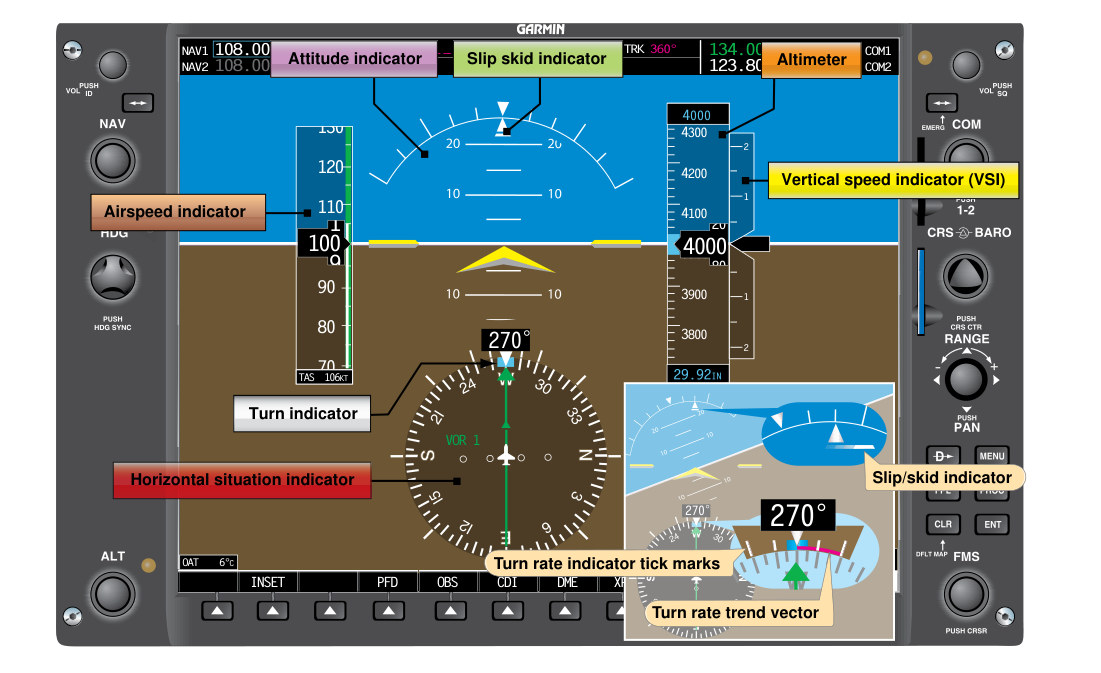
A glass cockpit trades individual mechanical instruments for electronic displays. The primary flight display gathers attitude, airspeed, altitude, heading, and vertical speed onto one screen, while a multifunction display shows moving maps and engine information. Behind the screens, solid-state sensors such as an attitude and heading reference system and an air data computer replace the mechanical gyros and pitot-static instruments, but they need electrical power to work. The transponder answers ATC radar: Mode A sends only the assigned code, Mode C adds altitude reporting, and Mode S adds a data link. Pilots must know the standard VFR code of 1200 and the emergency codes — 7500 for hijack, 7600 for lost communications, and 7700 for a general emergency — and many operations require ADS-B Out to broadcast position. Finally, GPS uses satellite signals to fix position, and area navigation (RNAV) lets the airplane fly directly between points rather than following ground navaids. Approved GPS/WAAS equipment may support IFR RNAV (GPS) approaches — including approaches with vertical guidance such as LPV — when the equipment is approved, the navigation database is current, RAIM/WAAS availability is confirmed, and the published procedure is authorized. Together these avionics boost situational awareness while still demanding a pilot who understands their limits. Between steam gauges and full glass, many airplanes carry a horizontal situation indicator (HSI), which merges the heading indicator and the VOR/ILS course deviation indicator into one instrument: a rotating compass card shows heading under a fixed aircraft symbol while a course pointer and deviation bar show the selected course and left/right displacement. Combining heading and course on one face reduces workload and the chance of reverse-sensing errors.
Key terms
- Primary flight display (PFD)
- An electronic display combining the primary flight instruments on one screen.
- Transponder
- Equipment that replies to ATC radar with a code and, in Mode C, altitude.
- RNAV
- Area navigation allowing flight on any desired path between points.
- HSI
- Horizontal situation indicator — combines the heading indicator and VOR/ILS course deviation indicator in one instrument.
Sources & references · 4 · 4 linked
Every claim traces to a source — paraphrased knowledge elements pointing at the governing FAA publication. Items marked verified have been checked against the retrieved source text; the rest are pending verification. Where the exact page or regulation has been located in a retrieved document, the source links straight to it.
- PHAK Ch. 8 — Pilot’s Handbook of Aeronautical Knowledge verifiedPHAK Ch. 8 (p. 203)
- AIM 4-1-20 — Aeronautical Information Manual verifiedAIM 4-1-20 (p. 43)
- AIM 1-1-17 — Aeronautical Information Manual verifiedAIM 1-1-17 (p. 41)
- PHAK Ch. 8 — Pilot’s Handbook of Aeronautical Knowledge verifiedPHAK Ch. 8 (p. 203)
Community
Ask for more detail or suggest additions to make this lesson better. Community input — not authoritative and not CFI-reviewed.
Sign in or create a free account to join the conversation.
No comments yet — be the first to help improve this lesson.