VFR · Lesson 40 · 8 min · ACS PA.I.C
The Atmosphere: Stability, Moisture and Density Altitude
Reviewed by a panel of three CFIs + AI review
Summary
Stability sets turbulence and cloud form; the temperature/dewpoint spread warns of fog; pressure gradients and Coriolis drive the wind; and density altitude links heat and altitude to performance.
Also watch
Quick check ▾
One question on what you just read.
Question 1 of 1
Atmospheric stability and lapse rate · Topic mastery: Not started
Exit0 of 1 answered
Which conditions are characteristic of unstable air?
Why this matters in flight
The state of the atmosphere decides whether your flight is smooth or turbulent, whether visibility is good or fog closes the airport, and whether your airplane can even climb out of the runway. These fundamentals underlie every weather product you will read.
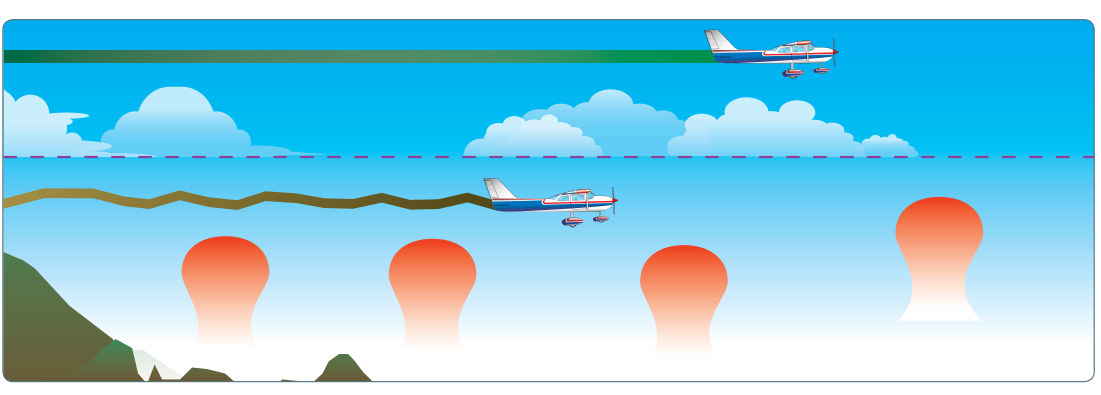
Weather begins with the behavior of air. Stability describes whether a parcel of lifted air sinks back down (stable) or keeps rising on its own (unstable). Stable air gives smooth flying, poor visibility, and flat stratiform clouds; unstable air gives turbulence, good visibility, and towering cumuliform clouds. Moisture is measured by the dewpoint — the temperature at which the air becomes saturated. When temperature and dewpoint are close, fog or low clouds become likely, which is why a small temperature/dewpoint spread is a red flag. Pressure drives the wind: air moves from highs to lows, and the Coriolis force bends that flow so surface winds circle clockwise out of a high and counterclockwise into a low. Finally, density altitude ties temperature and altitude to performance: hot, high, and humid conditions thin the air, robbing the wing, propeller, and engine of the dense air they need, so takeoff and climb suffer.
Key terms
- Stability
- The tendency of lifted air to sink back (stable) or keep rising (unstable).
- Dewpoint
- The temperature to which air must cool to become saturated.
- Density altitude
- Pressure altitude corrected for temperature; the altitude the airplane "feels".
Sources & references · 4 · 4 linked
Every claim traces to a source — paraphrased knowledge elements pointing at the governing FAA publication. Items marked verified have been checked against the retrieved source text; the rest are pending verification. Where the exact page or regulation has been located in a retrieved document, the source links straight to it.
- Aviation Weather Handbook FAA-H-8083-28 / PHAK Ch. 12 — Aviation Weather Handbook verifiedWeather Handbook (document)
- Aviation Weather Handbook FAA-H-8083-28 / PHAK Ch. 12 — Aviation Weather Handbook verifiedWeather Handbook (document)
- PHAK Ch. 12 / Aviation Weather Handbook FAA-H-8083-28 — Pilot’s Handbook of Aeronautical Knowledge verifiedPHAK Ch. 12 (p. 285)
- PHAK Ch. 12 / Aviation Weather Handbook FAA-H-8083-28 — Pilot’s Handbook of Aeronautical Knowledge verifiedPHAK Ch. 12 (p. 285)
Community
Ask for more detail or suggest additions to make this lesson better. Community input — not authoritative and not CFI-reviewed.
Sign in or create a free account to join the conversation.
No comments yet — be the first to help improve this lesson.