VFR · Lesson 39 · 8 min · ACS PA.III.A · ACS PA.I.E
Light Gun Signals and Lost Communication
Reviewed by a panel of three CFIs + AI review
Summary
Light gun in flight: steady green = land, steady red = give way, flashing red = airport unsafe. On lost comm, squawk 7600, troubleshoot, stay VFR, and watch the tower for a light signal.
Also watch
Quick check ▾
One question on what you just read.
Question 1 of 1
Light gun signals · Topic mastery: Not started
Exit0 of 1 answered
A steady green light gun signal directed at an aircraft in flight means what?
Why this matters in flight
A radio can fail at the worst moment — on approach to a towered airport. Knowing the light gun signals and the lost-communication procedure lets you land safely without ever saying a word.
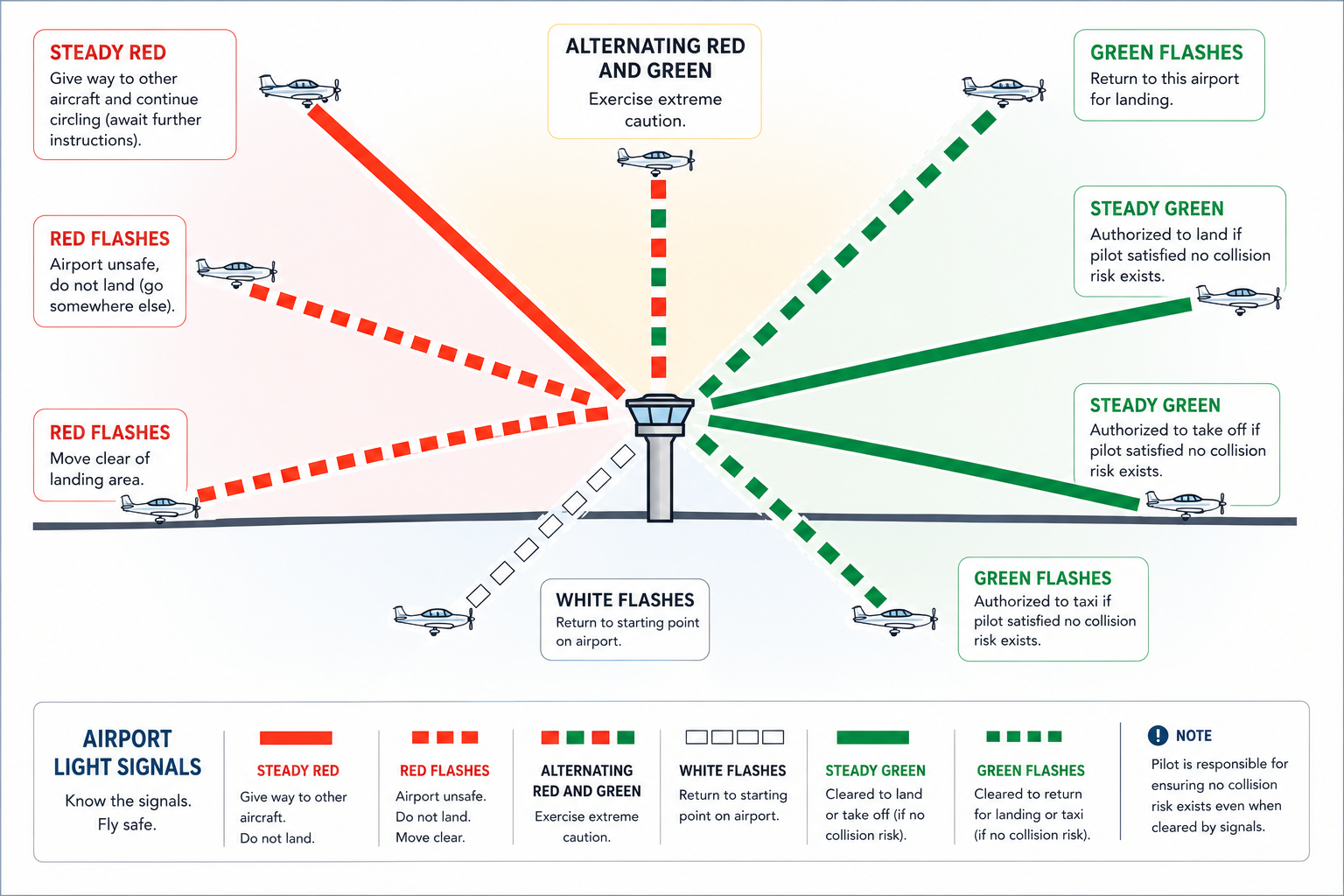
When the radio quits, a control tower can still direct you with a light gun. In flight, a steady green means cleared to land, a steady red means give way and keep circling, a flashing green means return for landing, a flashing red means the airport is unsafe so do not land, and alternating red and green means exercise extreme caution. On the ground the signals shift meaning, and a flashing white tells you to return to your starting point. The lost-communication procedure begins with squawking 7600 and troubleshooting the obvious first — volume, the selected frequency, and headset connections — because many apparent failures are just configuration errors. A VFR pilot then stays in visual conditions, proceeds to a suitable airport, and watches the tower for a light gun signal to receive a landing clearance.
Key terms
- Steady green (in flight)
- Cleared to land.
- Flashing red (in flight)
- Airport unsafe — do not land.
- Squawk 7600
- The transponder code for a two-way radio communication failure.
Sources & references · 2 · 3 linked
Every claim traces to a source — paraphrased knowledge elements pointing at the governing FAA publication. Items marked verified have been checked against the retrieved source text; the rest are pending verification. Where the exact page or regulation has been located in a retrieved document, the source links straight to it.
- AIM 4-3-13 — Aeronautical Information Manual verifiedAIM 4-3-13 (p. 44)
- AIM 6-4 / 14 CFR 91.185 — Aeronautical Information Manual verified14 CFR 91.185AIM 6-4 (p. 511)
Community
Ask for more detail or suggest additions to make this lesson better. Community input — not authoritative and not CFI-reviewed.
Sign in or create a free account to join the conversation.
No comments yet — be the first to help improve this lesson.