VFR · Lesson 34 · 6 min · ACS PA.I.E
VFR Weather Minimums
Reviewed by a panel of three CFIs + AI review
Summary
Class B: 3 SM, clear of clouds. Class C/D/E <10,000: 3 SM + 500/1,000/2,000. Class G day low: 1 SM, clear of clouds. Special VFR (by ATC clearance) allows clear-of-clouds and 1 SM in a controlled surface area; at night it requires an instrument-rated pilot and instrument-equipped aircraft.
Also watch
Quick check ▾
One question on what you just read.
Question 1 of 1
VFR weather minimums by airspace · Topic mastery: Not started
Exit0 of 1 answered
What are the basic VFR weather minimums in Class B airspace?
Why this matters in flight
The visibility and cloud-clearance you legally need changes with the airspace you are in. These numbers appear on the knowledge test and keep you a safe distance from clouds where faster IFR traffic may emerge.
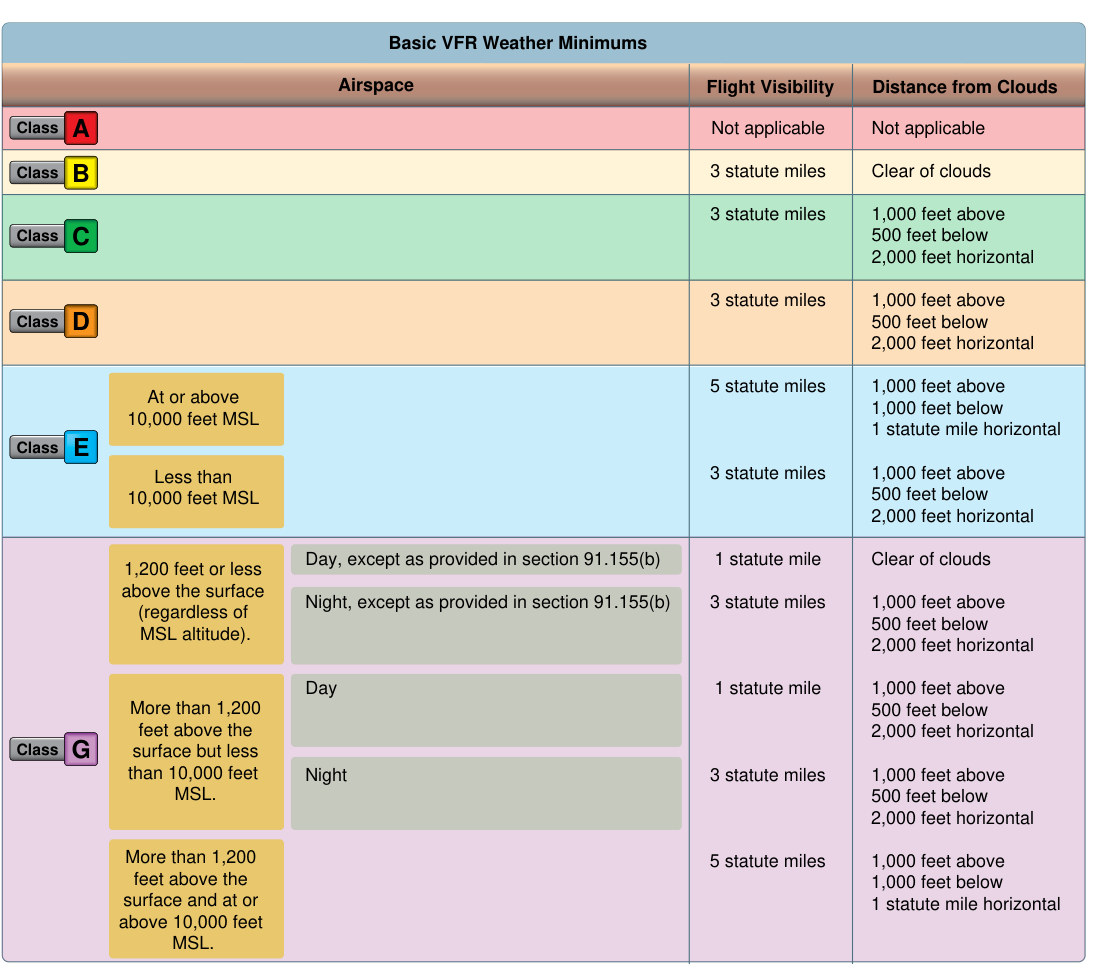
The core idea is that busier or higher airspace demands more room from clouds. In Class B, where ATC separates everyone, you only need 3 statute miles of visibility and to remain clear of clouds. In Class C, D, and E below 10,000 feet MSL you need 3 statute miles and the "3-152" cloud clearances: 500 feet below, 1,000 feet above, and 2,000 feet horizontally from clouds. Class G is the exception with lower requirements close to the ground during the day — 1 statute mile and clear of clouds below 1,200 feet AGL — because traffic is slower and lower there. The test wants the FULL Class G grid: below 1,200 AGL it is 1 SM/clear of clouds by day, and 3 SM with 3-152 clearances at night (except that an airplane in an airport traffic pattern within one-half mile of the runway may operate at night with 1 SM and clear of clouds). From 1,200 AGL up to but below 10,000 MSL, Class G requires 1 SM day / 3 SM night, both with 3-152 clearances. At or above 10,000 feet MSL (and more than 1,200 AGL), BOTH Class G and Class E require 5 statute miles with 1,000 below, 1,000 above, and 1 statute MILE horizontal — the faster traffic up high needs more room. Always confirm the exact values in the current regulation (14 CFR 91.155). When the weather at a controlled-airport surface area drops below these basic minimums, a pilot can ask ATC for a Special VFR (SVFR) clearance: with it you may operate remaining clear of clouds with at least 1 statute mile of visibility. SVFR must be requested from and granted by ATC, is not available where the airport is marked "No SVFR," and at night requires the pilot to be instrument rated and the aircraft to be instrument equipped.
Key terms
- Statute mile
- The unit used for flight visibility (not nautical miles).
- Cloud clearance
- Minimum distance you must keep from clouds under VFR.
- Special VFR (SVFR)
- An ATC clearance to operate below basic VFR minimums in a controlled surface area: clear of clouds with ≥1 SM visibility.
Sources & references · 2 · 2 linked
Every claim traces to a source — paraphrased knowledge elements pointing at the governing FAA publication. Items marked verified have been checked against the retrieved source text; the rest are pending verification. Where the exact page or regulation has been located in a retrieved document, the source links straight to it.
- 14 CFR 91.155 — 14 CFR Part 91 — General Operating and Flight Rules verified14 CFR 91.155
- 14 CFR 91.157 — 14 CFR Part 91 — General Operating and Flight Rules verified14 CFR 91.157
Community
Ask for more detail or suggest additions to make this lesson better. Community input — not authoritative and not CFI-reviewed.
Sign in or create a free account to join the conversation.
No comments yet — be the first to help improve this lesson.