VFR · Lesson 35 · 6 min · ACS PA.I.E
Special Use Airspace and Speed Limits
Reviewed by a panel of three CFIs + AI review
Summary
Know prohibited/restricted/warning/MOA/alert areas. Speed: 250 kt below 10,000 MSL; 200 kt under a Class B shelf and in the C/D speed zone.
Also watch
Quick check ▾
One question on what you just read.
Question 1 of 1
Airspace speed limits · Topic mastery: Not started
Exit0 of 1 answered
What is the maximum indicated airspeed below 10,000 feet MSL?
Why this matters in flight
Flying into an active restricted or prohibited area, or exceeding an airspace speed limit, is a regulatory violation and a real safety hazard. You need to recognize these areas on a chart.
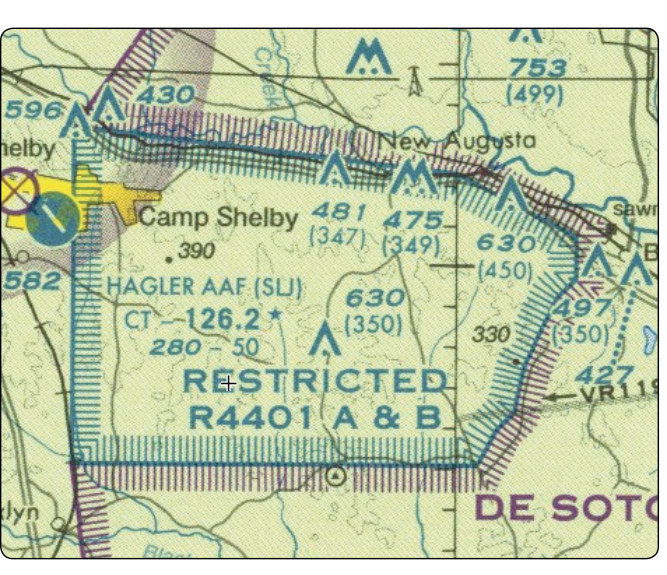
Special use airspace marks where activity may be hazardous to non-participating aircraft. Prohibited areas (for example over sensitive national locations) are off-limits entirely. Restricted areas contain hazards such as artillery or missile testing and require permission to enter when active. Warning areas lie over international waters, military operations areas (MOAs) separate military training from IFR traffic, and alert areas flag a high volume of a particular activity. For speed, the general rule below 10,000 feet MSL is a 250-knot limit. Inside Class C or D at or below 2,500 feet AGL within 4 nautical miles of the primary airport, and beneath a Class B shelf, the limit drops to 200 knots.
Key terms
- Prohibited area
- Airspace where flight is not allowed.
- MOA
- Military Operations Area; use caution and check whether it is active.
Sources & references · 2 · 2 linked
Every claim traces to a source — paraphrased knowledge elements pointing at the governing FAA publication. Items marked verified have been checked against the retrieved source text; the rest are pending verification. Where the exact page or regulation has been located in a retrieved document, the source links straight to it.
- AIM 3-4 / sectional legend — Aeronautical Information Manual verifiedAIM 3-4 (p. 183)
- 14 CFR 91.117 — 14 CFR Part 91 — General Operating and Flight Rules verified14 CFR 91.117
Community
Ask for more detail or suggest additions to make this lesson better. Community input — not authoritative and not CFI-reviewed.
Sign in or create a free account to join the conversation.
No comments yet — be the first to help improve this lesson.