VFR · Lesson 21 · 7 min · ACS PA.I.G · ACS PA.VIII
The Magnetic Compass and Its Errors
Reviewed by a panel of three CFIs + AI review
Summary
The magnetic compass suffers turning error (UNOS) and acceleration error (ANDS), both caused by magnetic dip, so pilots reset the heading indicator from the compass only during straight, unaccelerated flight.
Also watch
Quick check ▾
One question on what you just read.
Question 1 of 1
Magnetic compass errors · Topic mastery: Not started
Exit0 of 1 answered
Using the UNOS rule, what happens to the magnetic compass when rolling out onto a northerly heading?
Why this matters in flight
The magnetic compass is a reliable backup, but it misbehaves during turns and speed changes. Knowing its errors keeps you from chasing a swinging needle and rolling out on the wrong heading.
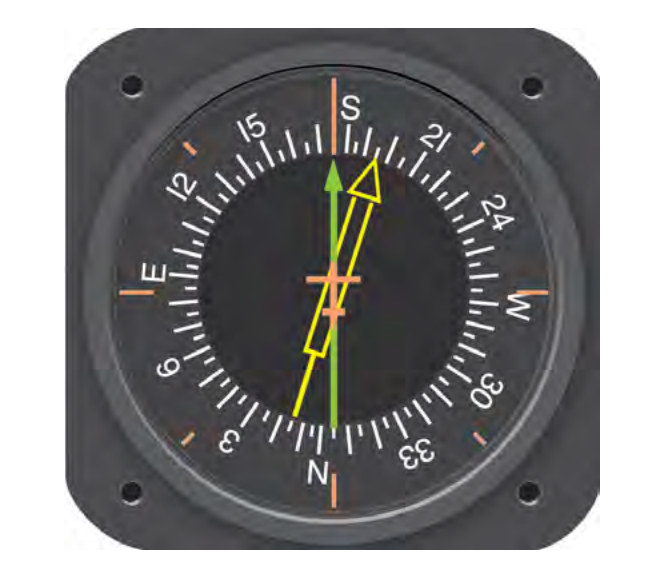
The magnetic compass is simple and needs no power, which makes it a valuable backup, but its readings are distorted whenever the aircraft turns or changes speed. These distortions come from magnetic dip, the compass’s tendency to tilt toward the magnetic pole. Two mnemonics capture the effects. Turning error is UNOS: Undershoot North, Overshoot South. When rolling out onto a northerly heading the compass lags behind, so you must stop the turn early; onto a southerly heading it leads, so you let the turn continue past the target. Acceleration error is ANDS: Accelerate North, Decelerate South. On an east or west heading, accelerating makes the compass indicate a turn toward north and decelerating toward south, even though the heading has not changed. Because these errors are largest near northerly and southerly headings and during speed changes, pilots rely on the heading indicator for steady reference and use the compass to reset it during straight, unaccelerated flight.
Key terms
- Magnetic dip
- The compass’s tendency to point downward toward the magnetic pole, causing turning and acceleration errors.
- UNOS
- Undershoot North, Overshoot South — the turning error mnemonic.
- ANDS
- Accelerate North, Decelerate South — the acceleration error mnemonic.
Sources & references · 1 · 1 linked
Every claim traces to a source — paraphrased knowledge elements pointing at the governing FAA publication. Items marked verified have been checked against the retrieved source text; the rest are pending verification. Where the exact page or regulation has been located in a retrieved document, the source links straight to it.
- PHAK Ch. 8 — Pilot’s Handbook of Aeronautical Knowledge verifiedPHAK Ch. 8 (p. 203)
Community
Ask for more detail or suggest additions to make this lesson better. Community input — not authoritative and not CFI-reviewed.
Sign in or create a free account to join the conversation.
No comments yet — be the first to help improve this lesson.