VFR · Lesson 78 · 9 min · ACS PA.I.F · ACS PA.II · ACS PA.XII
Documents, Inspections and Airworthiness
Reviewed by a panel of three CFIs + AI review
Summary
ARROW documents must be aboard; an annual is required yearly and a 100-hour for hire/instruction; the PIC judges airworthiness; and inoperative equipment follows the 91.213 process.
Also watch
Quick check ▾
One question on what you just read.
Question 1 of 1
Required aircraft documents (ARROW) · Topic mastery: Not started
Exit0 of 1 answered
The memory aid ARROW lists the documents that must be aboard an aircraft. What does the second "R" represent?
Why this matters in flight
A perfectly flyable airplane can still be illegal to fly if a certificate is missing or an inspection has lapsed. Sorting out documents, inspections, and inoperative equipment is what lets you sign for an airworthy aircraft with confidence.
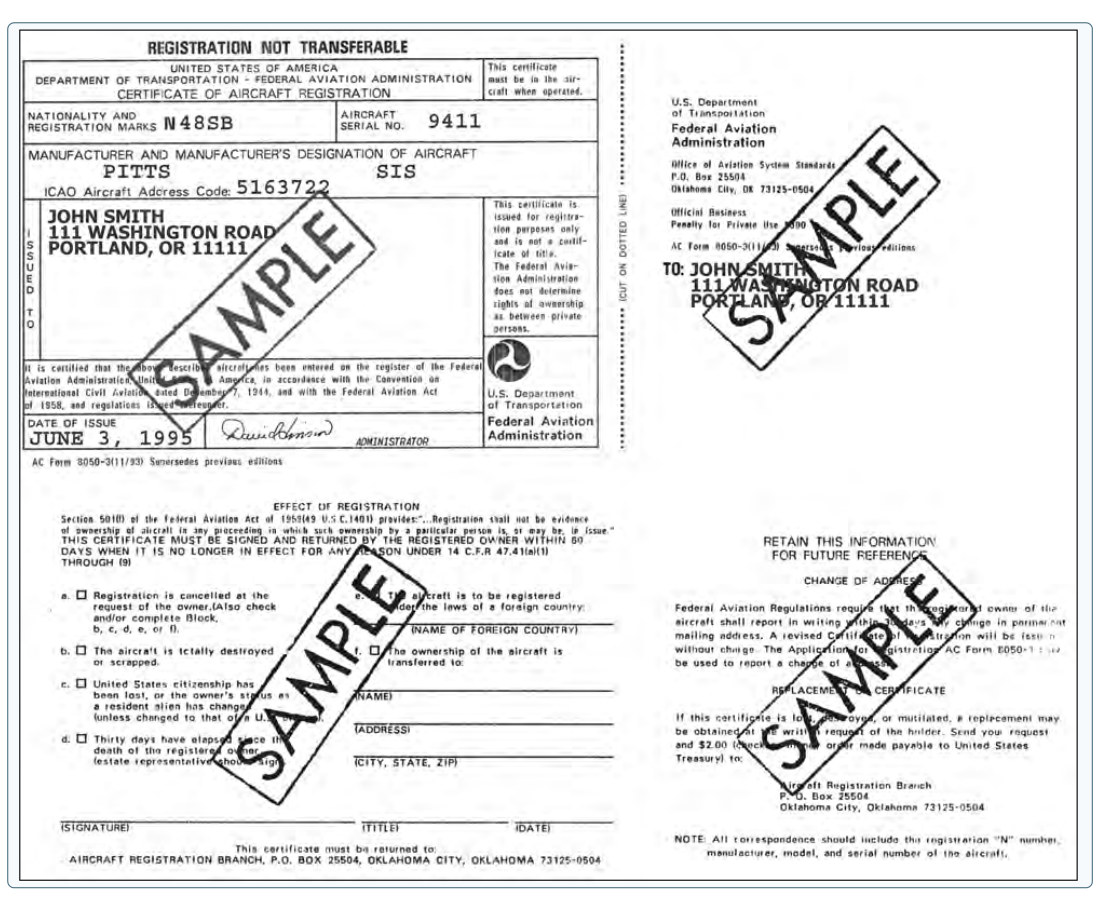
The documents that must be aboard are remembered as ARROW: Airworthiness certificate, Registration certificate, Radio station license (for international flights), Operating limitations (the flight manual, placards, and markings), and Weight and balance data. Airworthiness also depends on current inspections. Every aircraft needs an annual inspection within the preceding 12 calendar months; an aircraft flown for hire or used for flight instruction for hire also needs a 100-hour inspection. The PIC is ultimately responsible for deciding the aircraft is in condition for safe flight. When something is inoperative and no minimum equipment list applies, 91.213 requires you to confirm the item is not required by the equipment list, the VFR-day rule, an airworthiness directive, or the operation; then deactivate or remove it, placard it "inoperative," and judge that the aircraft is still safe. The maintenance details are heavily tested, so keep the intervals exact: the annual is 12 CALENDAR months (the 100-hour limit may be exceeded by no more than 10 hours, and only while en route to reach a place where the inspection can be done, with the overrun deducted from the next 100 hours in service); the transponder must be tested and inspected within the preceding 24 calendar months; the ELT gets inspected within 12 calendar months, and its battery is replaced or recharged after 1 cumulative hour of use or when 50 percent of its useful life has expired — test it only in the first five minutes after the hour, and monitor 121.5 before shutdown to confirm it is not transmitting. Airworthiness Directives are mandatory: the OWNER or OPERATOR is responsible for AD compliance and for maintaining the aircraft in an airworthy condition, and a pilot may perform only the preventive maintenance listed in Part 43 Appendix A — with every task entered in the maintenance records.
Key terms
- ARROW
- Airworthiness, Registration, Radio license, Operating limitations, Weight and balance.
- Annual inspection
- Required within the preceding 12 calendar months for all aircraft.
- 100-hour inspection
- Required for aircraft flown for hire or for flight instruction for hire.
Sources & references · 4 · 7 linked
Every claim traces to a source — paraphrased knowledge elements pointing at the governing FAA publication. Items marked verified have been checked against the retrieved source text; the rest are pending verification. Where the exact page or regulation has been located in a retrieved document, the source links straight to it.
- 14 CFR 91.9 / 91.203 (ARROW) — 14 CFR Part 91 — General Operating and Flight Rules verified14 CFR 91.914 CFR 91.203
- 14 CFR 91.409 / 91.417 — 14 CFR Part 91 — General Operating and Flight Rules verified14 CFR 91.40914 CFR 91.417
- PHAK Ch. 9 / 14 CFR 91.7 — Pilot’s Handbook of Aeronautical Knowledge verified14 CFR 91.7PHAK Ch. 9 (p. 231)
- 14 CFR 91.213 — 14 CFR Part 91 — General Operating and Flight Rules verified14 CFR 91.213
Community
Ask for more detail or suggest additions to make this lesson better. Community input — not authoritative and not CFI-reviewed.
Sign in or create a free account to join the conversation.
No comments yet — be the first to help improve this lesson.