Quick reference
Airport signs and markings: the six sign types and the hold-short lines
What do the different airport signs and hold-short markings mean?
Airports use six types of signs: mandatory instruction (white on red — hold unless cleared), location (yellow on black — where you are), direction, destination and information (black on yellow), and runway distance remaining (white numerals on black). AIM 2-3-7 AIM 2-3-8 AIM 2-3-9 AIM 2-3-10 AIM 2-3-11 AIM 2-3-12 AIM 2-3-13 The runway holding position marking is four yellow lines, two solid and two dashed; you hold on the solid side and, at a towered airport, never cross it without an ATC clearance. AIM 2-3-5
| Sign type | Colors | What it tells you | Figure 65 | Source |
|---|---|---|---|---|
| Mandatory instruction | White inscription on red | Entrance to a runway or critical area, or an area aircraft may not enter | A, B, C, D | AIM 2-3-8 |
| Location | Yellow inscription and border on black | The taxiway or runway you are on | E, F | AIM 2-3-9 |
| Direction | Black inscription on yellow, with arrows | The taxiways leading out of the next intersection | K | AIM 2-3-10 |
| Destination | Black inscription on yellow, with an arrow | The taxi route to a place on the airport, or to departure runways | I, J | AIM 2-3-11 |
| Information | Black inscription on yellow | Frequencies, noise abatement, areas the tower cannot see | — | AIM 2-3-12 |
| Runway distance remaining | White numeral on black | Thousands of feet of landing runway left | L | AIM 2-3-13 |
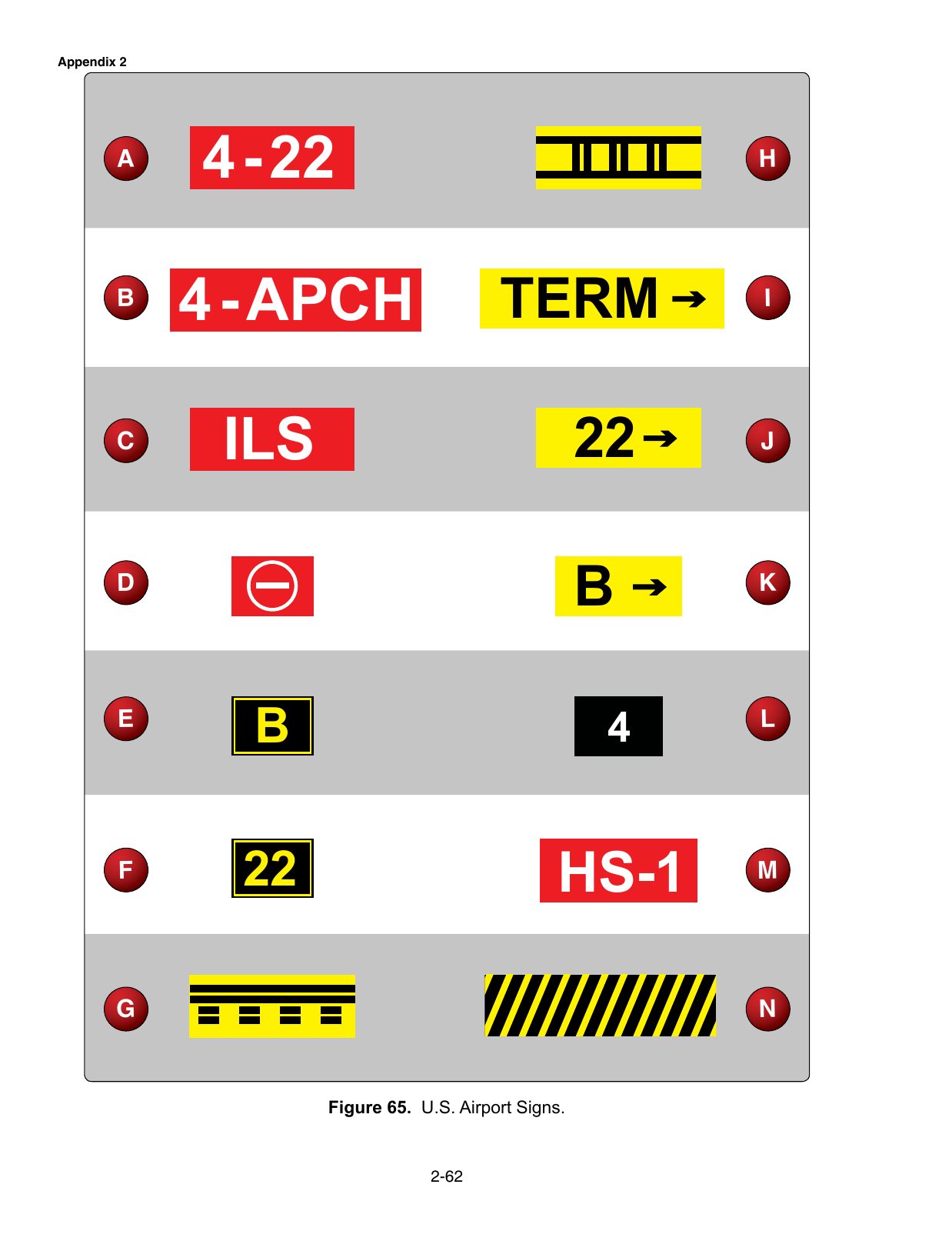
Mandatory instruction signs: red means hold
Mandatory instruction signs have a white inscription on a red background and mark an entrance to a runway or critical area, or an area where aircraft are prohibited from entering. AIM 2-3-8 A runway holding position sign shows the runway designations in the direction of each threshold: “15-33” means the threshold of Runway 15 is to your left and Runway 33 to your right. At the beginning of the takeoff runway, the sign may show only the takeoff runway. AIM 2-3-8 Other red signs include the runway approach area holding position sign (for example “15-APCH”), the “ILS” critical area holding position sign, and the no entry sign, a white circle with a horizontal bar. AIM 2-3-8
Location, direction and destination signs
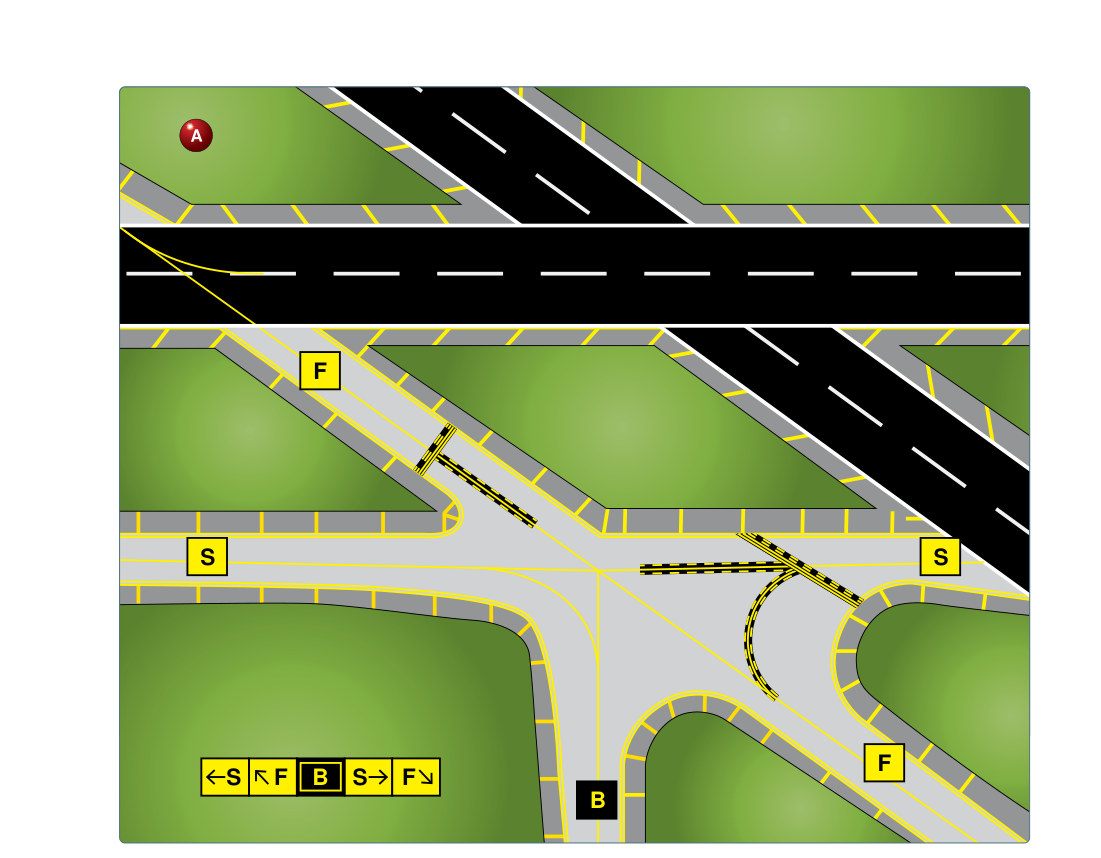
A location sign — yellow inscription and yellow border on black — names the taxiway or runway you are on, and often stands beside a direction sign or a runway holding position sign. AIM 2-3-9 Direction signs are normally on the left before the intersection. Their designations are arranged clockwise starting from the first taxiway on your left, each with its own arrow. AIM 2-3-10 Destination signs always carry an arrow toward the destination: inbound signs name areas such as RAMP, FUEL or TERM, and outbound signs show departure runway numbers. AIM 2-3-11 Two black-on-yellow signs face pilots leaving an area: the runway boundary sign and the ILS critical area boundary sign show where you are clear of the runway or the critical area. AIM 2-3-9
Runway distance remaining signs
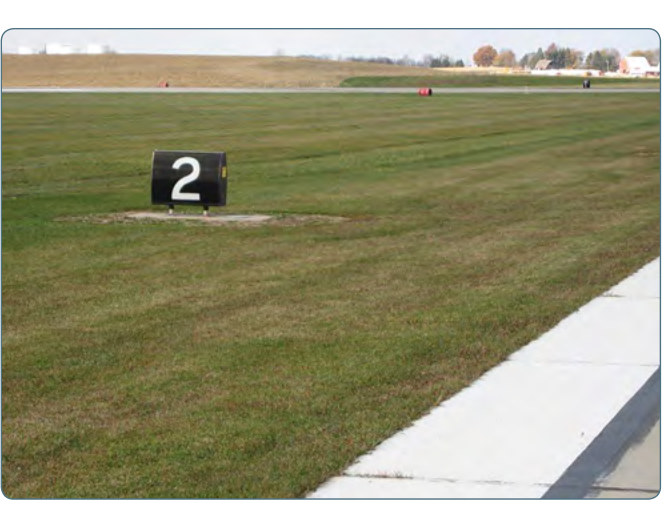
Runway distance remaining signs have a white numeral on black and show the landing runway left in thousands of feet; the last sign, “1”, stands at least 950 feet from the runway end. AIM 2-3-13
Hold-short and other markings
- Runway markings are white; markings for taxiways, closed or hazardous areas and holding positions are yellow, even when they are painted on a runway. AIM 2-3-2
- Runway holding position marking: two solid and two dashed yellow lines across the taxiway. The solid lines are always on the side where you must hold; when told “hold short of Runway XX,” stop so that no part of the aircraft extends past them. AIM 2-3-5
- Leaving a runway, you are not clear of it until every part of the aircraft has crossed the holding position marking. AIM 2-3-5
- Enhanced taxiway centerline: yellow dashed lines on both sides of the centerline for up to 150 feet before a runway holding position marking, warning you to prepare to stop. AIM 2-3-4
- ILS critical area holding position marking: two solid yellow lines 2 feet apart joined by pairs of solid lines 10 feet apart, a “ladder”. When ATC tells you to hold short of the ILS critical area, stop so that no part of the aircraft extends beyond it. AIM 2-3-5
- Taxiway intersection holding position marking: a single dashed yellow line across the taxiway, used where ATC holds you short of another taxiway. AIM 2-3-5
- A temporarily closed runway is marked with yellow crosses at each end. AIM 2-3-6
- At an airport with an operating control tower, you need an ATC clearance to taxi on a runway or taxiway, and to take off or land. 14 CFR 91.129(i)
Common mistakes
- Holding on the wrong side of the hold line. Approaching a runway you meet the solid lines first and hold there; the dashed side faces the runway. AIM 2-3-5
- Mixing up location and direction signs. A location sign (yellow on black) says where you are; a direction sign (black on yellow) says where the next taxiways go. AIM 2-3-9 AIM 2-3-10
- Stopping short of the runway exit and thinking you are clear. You are clear only when the whole aircraft is past the holding position marking. AIM 2-3-5
- Reading a distance-remaining “2” as 200 feet. The numeral counts thousands of feet, so “2” means 2,000 feet of runway left. AIM 2-3-13
Quick answers
What does a red airport sign mean?
It is a mandatory instruction sign: an entrance to a runway or critical area, or an area aircraft may not enter. At a towered airport you need a clearance to go past it. AIM 2-3-8 14 CFR 91.129(i)
Which side of the hold-short line do I stop on?
The side with the two solid lines. The solid lines are always on the holding side. AIM 2-3-5
What does a black sign with a yellow letter mean?
It is a location sign: the letter is the taxiway you are on. AIM 2-3-9
How many types of airport signs are there?
Six: mandatory instruction, location, direction, destination, information and runway distance remaining. AIM 2-3-7
Test yourself
Ten practice questions on this topic, graded with explanations. No signup needed.
Learn it properly
- Lesson: Airport Signs
- Lesson: Runway and Taxiway Markings
- Regulation: 14 CFR 91.129 on the eCFR ↗
Sources
14 CFR (2025 annual edition, as hosted on this site; current text on the eCFR) and the Aeronautical Information Manual (Basic, with Changes 1 and 2). Checked 2026-09-27.
AIM 2-3-7 AIM 2-3-8 AIM 2-3-9 AIM 2-3-10 AIM 2-3-11 AIM 2-3-12 AIM 2-3-13 AIM 2-3-5 AIM 2-3-2 AIM 2-3-4 AIM 2-3-6 14 CFR 91.129(i)
Study reference only. Written by PPL Free Ground School from the current FAA regulations and the Aeronautical Information Manual, and reviewed through our AI instructional-review system — not by a certificated flight instructor. We are not affiliated with or approved by the FAA, and this page is not an authoritative source: confirm against the current eCFR, the AIM and your instructor before you fly.