VFR · Lesson 13 · 9 min · ACS PA.VII · ACS PA.I.G
Stability, the Three Axes and Coordinated Flight
Reviewed by a panel of three CFIs + AI review
Summary
The airplane rolls, pitches, and yaws about three axes via ailerons, elevator, and rudder. CG position sets longitudinal stability, and rudder cancels the adverse yaw created when rolling into a turn.
Also watch
Quick check ▾
One question on what you just read.
Question 1 of 1
Stability and center of gravity · Topic mastery: Not started
Exit0 of 1 answered
How does a forward center of gravity generally affect longitudinal stability?
Why this matters in flight
Stability and the flight controls determine how the airplane responds to your inputs and to disturbances. Understanding adverse yaw is what makes the difference between a sloppy, skidding turn and a smooth, coordinated one.
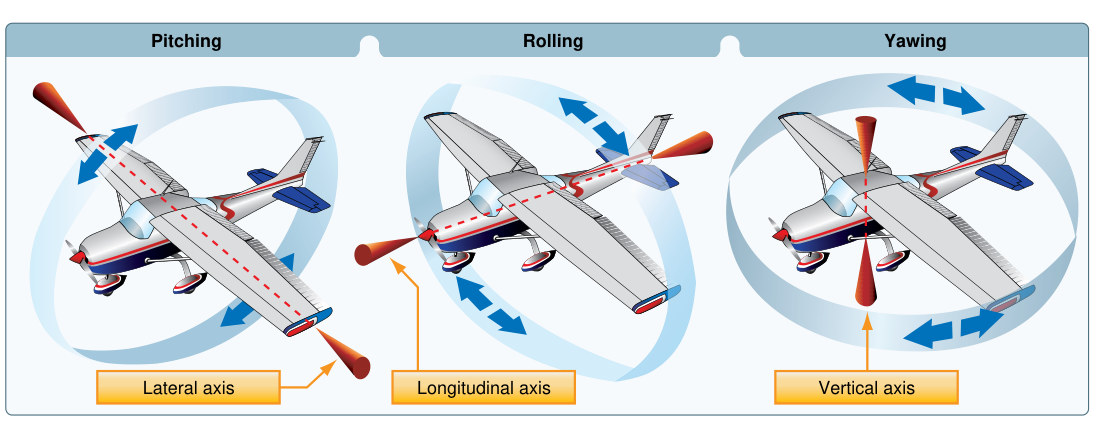
An airplane rotates about three axes that all pass through the center of gravity: the longitudinal axis (roll, controlled by the ailerons), the lateral axis (pitch, controlled by the elevator), and the vertical axis (yaw, controlled by the rudder). Stability describes how the airplane responds when disturbed. Positive static stability is the initial tendency to return to the original condition, and positive dynamic stability means the resulting oscillations dampen out. Longitudinal stability depends heavily on center-of-gravity location: a forward CG is more stable but heavier on the elevator, while an aft CG reduces stability and can become dangerous. When you roll into a turn, the outside wing’s down-aileron produces more lift and more induced drag, yawing the nose away from the turn — this is adverse yaw. Applying rudder in the direction of the turn cancels it and keeps the flight coordinated.
Key terms
- Static stability
- The initial tendency to return to the original condition after a disturbance.
- Adverse yaw
- The yaw away from a turn caused by the down-aileron’s extra induced drag.
- Three axes
- Longitudinal (roll), lateral (pitch), and vertical (yaw), all through the CG.
Sources & references · 3 · 3 linked
Every claim traces to a source — paraphrased knowledge elements pointing at the governing FAA publication. Items marked verified have been checked against the retrieved source text; the rest are pending verification. Where the exact page or regulation has been located in a retrieved document, the source links straight to it.
- PHAK Ch. 5 — Pilot’s Handbook of Aeronautical Knowledge verifiedPHAK Ch. 5 (p. 98)
- PHAK Ch. 5 — Pilot’s Handbook of Aeronautical Knowledge verifiedPHAK Ch. 5 (p. 98)
- PHAK Ch. 5 — Pilot’s Handbook of Aeronautical Knowledge verifiedPHAK Ch. 5 (p. 98)
Community
Ask for more detail or suggest additions to make this lesson better. Community input — not authoritative and not CFI-reviewed.
Sign in or create a free account to join the conversation.
No comments yet — be the first to help improve this lesson.