VFR · Lesson 42 · 8 min · ACS PA.I.C
Weather Hazards: Thunderstorms and Icing
Reviewed by a panel of three CFIs + AI review
Summary
Thunderstorms need moisture, instability, and lift, and are deadliest in the mature stage — avoid them widely. Icing needs visible moisture plus freezing temperatures and degrades lift; without ice protection, stay out of it.
Also watch
Quick check ▾
One question on what you just read.
Question 1 of 1
Thunderstorm hazards and lifecycle · Topic mastery: Not started
Exit0 of 1 answered
Which stage of a thunderstorm is the most hazardous, marked by both updrafts and downdrafts?
Why this matters in flight
Thunderstorms and structural icing are among the most lethal weather threats to a light airplane. Knowing what they need to form, and when they are most dangerous, is what keeps a VFR pilot from stumbling into conditions the aircraft cannot handle.
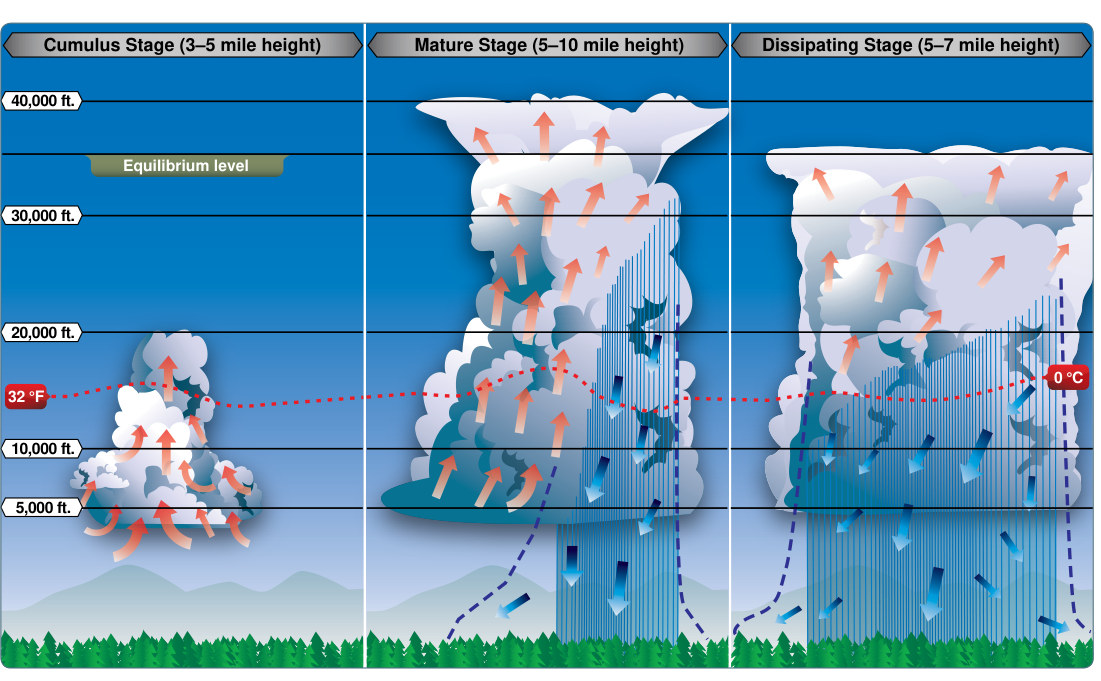
Thunderstorms require three ingredients working together: moisture, unstable air, and a lifting force. Once formed, a storm moves through three stages — the cumulus stage of building updrafts, the mature stage where updrafts and downdrafts coexist with heavy rain, lightning, and possible hail, and the dissipating stage of weakening downdrafts. The mature stage is the most hazardous, bringing severe turbulence, wind shear, microbursts, and hail, so the rule is to give any thunderstorm a wide berth rather than fly under or through it. Structural icing is a separate hazard that needs two things at once: visible moisture and a surface temperature at or below freezing. Ice adds weight and spoils the airflow over the wing, cutting lift and adding drag. Clear ice from large supercooled droplets is dense and stubborn, while rime ice from small droplets is rough and brittle. An airplane without ice protection has no business in known icing.
Key terms
- Mature stage
- The most hazardous thunderstorm stage, with both updrafts and downdrafts.
- Supercooled droplet
- A liquid water droplet existing below freezing that freezes on impact.
- Clear vs rime ice
- Clear ice is dense and hard to remove; rime ice is rough and opaque.
Sources & references · 2 · 2 linked
Every claim traces to a source — paraphrased knowledge elements pointing at the governing FAA publication. Items marked verified have been checked against the retrieved source text; the rest are pending verification. Where the exact page or regulation has been located in a retrieved document, the source links straight to it.
- Aviation Weather Handbook FAA-H-8083-28 / PHAK Ch. 12 — Aviation Weather Handbook verifiedWeather Handbook (document)
- Aviation Weather Handbook FAA-H-8083-28 / PHAK Ch. 12 — Aviation Weather Handbook verifiedWeather Handbook (document)
Community
Ask for more detail or suggest additions to make this lesson better. Community input — not authoritative and not CFI-reviewed.
Sign in or create a free account to join the conversation.
No comments yet — be the first to help improve this lesson.